The chicory season is now in full swing in Belgium. And while the recurring theme almost every year is that growers are getting older and fewer remain, 39-year-old Tom Van Bael is an exception to the rule. The passionate Brussels white lettuce grower grew up with his hands in the soil. When hydro chicory began to emerge, his father decided to stop cultivating in the 1990s, but six years ago, Tom took it up again. Despite the challenges, he is happy he made that decision. "The blood runs where it can't go, so I was just eager to take it on again," says the grower of the Haacht-based chicory company of the same name.
 © Grondwitloof Van Bael
"Even though I only restarted recently, I've never really known anything else," Tom laughs. "Brussels chicory has been in our family for more than a hundred years. I started it myself six years ago, but cultivation has been passed down for four generations. My great-grandfather began, and then my grandfather took over. He had three children: my father and two uncles. The two eldest sons, including my father, worked with my grandfather on the farm, where they combined livestock farming and chicory. In the 1990s, however, hydroponics took off in the Kampenhout area. Many growers switched to hydro chicory. Supermarkets and auctions made no distinction between the two, so the price plummeted. With three families, they could no longer make a living, so my father decided to stop. My grandfather and uncle, however, continued growing."
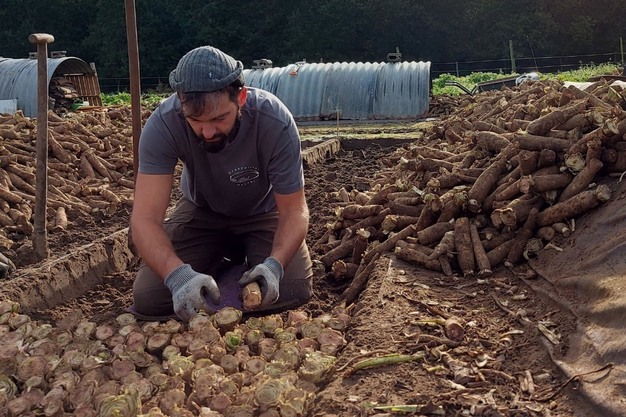
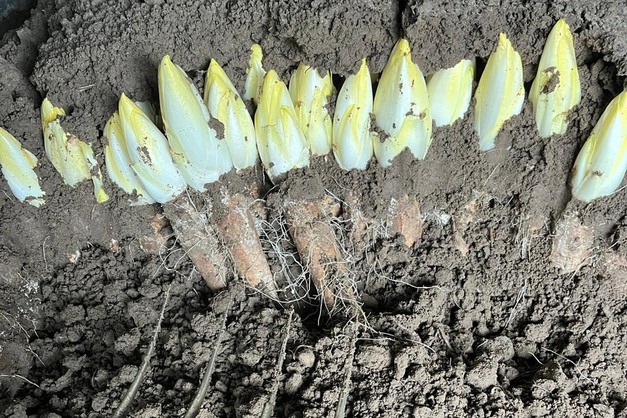
"My father then became a heavy transport instructor out of necessity, but his heart always remained in white leaf cultivation," he explains. "He never even considered switching to hydroponics. We're really against that. We still grow outdoors, under corrugated sheets, just as they did a hundred years ago. We do that purely for the sake of quality. We built a new shed, but that's concrete. You could put soil in there to grow white leaves, but in a shed, you don't have nature: It doesn't rain, it doesn't freeze, it doesn't live, it doesn't breathe. Outside is different. For us, it's simple: Either Brussels white leaves, or nothing."
So when Tom decided to take up the gauntlet again six years ago, the family's enthusiasm was immediate. "As a child, I helped clean chicory and work in the fields. My parents made me weed, but not the thin plants, because I might have pulled out the wrong ones. Six years ago, I sat at my parents' kitchen table and said I wanted to start my own business. My grandparents still had some roots lying around, a small layer of five to ten. I thought, we have the space, why not? That's how we started, with a wheelbarrow and a shovel. I just really wanted to do it again and decided to jump back in. And without my father, I couldn't have done it."
 © Grondwitloof Van Bael
Reliable marketing partners
Of course, there were challenges. "It's hard work and not always easy financially. Until the New Year, prices are usually good, but after that, they often drop. The costs, however, continue: cultivation, crop protection, rent... When your carrots cost more than the chicory brings in per kilo, you know what time it is. Fortunately, we now have a lot of direct sales at home. At first, it was difficult. People didn't know us or what quality we offered. Now they come from far and wide."
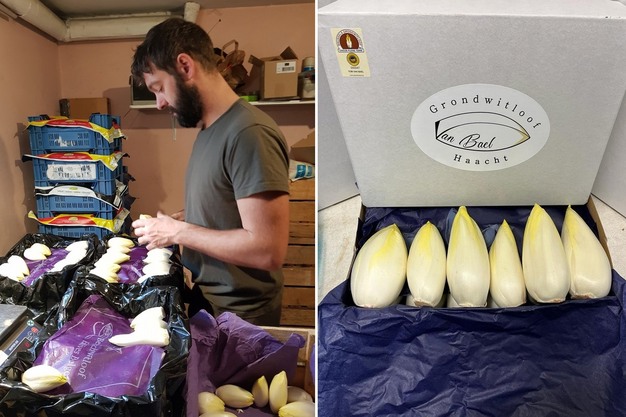
"For years, we also supplied a wholesaler that packed for Delhaize and Carrefour. We did that for five or six years, but prices fluctuated too much. They followed the auction, so of course, they couldn't suddenly pay us double. Luckily, we've now found a reliable sales partner in Cru, the fresh market that's part of Colruyt. And there's even a Dutch wholesaler who wants to buy our chicory for restaurants. They'll visit us soon for an interview. But it has to remain manageable. We can't deliver 300 or 400 kilos a week. We already deliver 400 to 500 kilos a week to Cru, which would bring us close to 1,000 kilos. Then it starts to look like mass production, and we don't want that."
Difference between Brussels and Brabant chicory
Tom feels that too little distinction is made between Brussels and Brabant chicory. "The cultivation is completely different. Brussels chicory grows in clay soil, with its own selections. The heads may be less uniform and not always perfect, but the taste is much better. It's hard to describe, but people recognize it as soon as they taste it. We package the chicory ourselves in crates or tomato trays. If we send it to a wholesaler, it's never labeled as 'Brussels chicory'. It automatically gets sold as 'Brabant'. The only way to keep the 'Brussels' name is to package it ourselves. The boxes we deliver to Cru do have a sticker with 'Brussels' on them."
 © Grondwitloof Van Bael
They now grow this Brussels chicory on about three hectares. "At the moment, we have three hectares of roots, good for about 40 to 50 layers of chicory, so in winter, we work hard. There's a huge amount of labor involved. Not just digging up the carrots, but also moving the soil. An 8m by 2m plot yields three cubic metres of soil that has to be moved each time. Brabant growers have much less of that work."
More sweet than bitter chicory
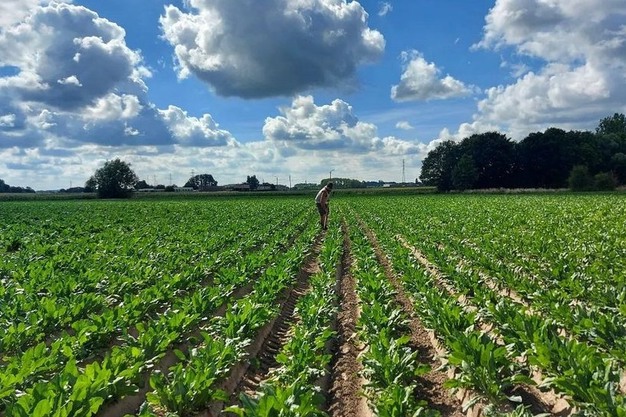
With the current season in full swing, it's all hands on deck. Nevertheless, he's satisfied. "This season looks good for us. The carrots got a lot of sun this summer, which means they have a lot of sugar. You can see that in the sugar beet, too: They had exceptionally high sugar values this year. We also see this in the chicory roots. They contain a lot of sugar, which is always positive. I even think the chicory tastes a bit sweeter this season than in other years. There's very little bitterness in it. Really nice quality."
"As for demand, it remains high," he explains. "We never really have problems with that. On the contrary, demand keeps growing, especially as more growers quit every year. Last year, for example, I took over the home sales of a colleague who stopped a few kilometres away. His customers now come to us. Those people just want to be sure there's always chicory available. If they come once or twice and there's nothing, they obviously won't return. That's why we always try to have enough stock."
 © Grondwitloof Van Bael
Chicory more prominent
Despite the steady demand, Tom believes promotional efforts could be stronger. "I think there should be more promotion for Brussels chicory. There are initiatives, such as the Week of Chicory in February, but they focus on chicory in general. There should be more emphasis on seasonal, traditional chicory cultivation. People need to learn to eat according to the season again. There shouldn't be chicory in the shops in summer, just as there aren't white asparagus then either."
"Moreover, Brussels chicory sometimes sells for 16 to 18 euros per kilo in the supermarket, while hydro chicory costs 3 to 4 euros. Then I understand that young families choose the cheaper option. At our home sales, I mainly see customers in their fifties or sixties, people who appreciate quality but can also afford it. Still, it would be nice if the price difference narrowed. We charge a fixed, fair price all year round. Not the highest, not the lowest. At the auction, the price can sometimes rise to 9 or 10 euros per kilo, but we don't increase ours with it. We want to remain fair to our regular customers."
More than worth it
Despite these challenges, he doesn't share the fear that whites will disappear in a few years' time. "We're definitely not stopping. We have steady sales and loyal customers, and as long as the quality remains good, I'm optimistic. Of course, there's stress. Chicory has to be ready every week, especially when supplying shops. And growing outside makes us more vulnerable to the weather. If it snows or freezes, we have to cover with plastic and add extra heating, because the cold water also needs to come up to temperature. All that is easier in a shed, but for me, it doesn't belong there. It's hard work, but it's still more than worth it."
For more information:
Tom Van Bael
Grondwitloof Van Bael
Damweg 29,
3150 Haacht, Belgium
+32 4 971 812 97
[email protected]
www.grondwitloofvanbael.be