German batches clearly predominated, supplemented only in some cases by a few potato imports from France and the Netherlands. There was a wide range of varieties available, and the quality was impressive. According to the BLE, availability increased and exceeded storage capacity in some places. Traders, therefore, had to offer discounts in some cases. Only Berlin reported price increases for French Charlotte potatoes. 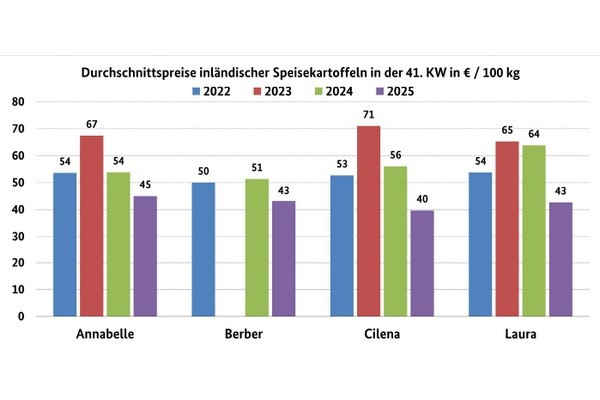 © BLE
© BLE
Lower Saxony:
More and more producers were able to complete their table potato harvest last week. Nevertheless, the market continued to be supplied with freshly harvested produce. Prices remained stable with no significant changes. Most farms will likely complete their table potato harvest this week. "Potatoes are flooding the market from all sides," sums up one producer.
The main harvest is now at its peak. The quality is satisfactory, although damage from pests and other causes continues to increase. "We expect to be supplied with field produce until November. Our export activities are slowly picking up speed," says Heidesand eG.
North Rhine-Westphalia:
The storage of table potatoes has largely been completed. Processors are very quality-conscious in the industrial potato market. Quality assurance must therefore be the top priority during harvesting and storage: "Quality before quantity."
Schleswig-Holstein:
The potato harvest in this region is in its final stages and has already been completed on many farms. The market continues to suffer from an abundant supply. Only loads of impeccable quality can be marketed at all. Accordingly, only such loads are being stored. With this year's very good yields pushing storage capacities to their limits, many potatoes continue to end up in alternative uses. In some cases, entire fields are no longer being harvested due to the oversupply. In the industrial potato sector, too little has changed in the initial situation, but a bottoming out seems to be setting in.
Rhineland-Palatinate:
On the potato market, producer prices are stabilizing at the low level they have reached. Food retailers are promoting table potatoes in broad-based campaigns, mostly without undercutting previous consumer prices. Despite the main harvest being well advanced over a large area, fresh field produce is likely to maintain supply pressure for some time. To combat the glasswing cicada, it was decided to ease the GLÖZ-compliant implementation of bare fallow from 2026.
Saxony:
Potato prices in Saxony have been stable for several weeks.
Hesse:
There were also no price changes in Hesse compared to the previous week. "The quantity is at the upper end of the scale this year," says Matthias Bott from the farm of the same name in Schauenburg. However, sales are still more subdued than usual. "This is because many people grow their own potatoes and there are numerous special offers in supermarkets," says the Schauenburg farmer. He will store the fresh potatoes, most of which he sells in the region, over the winter. In normal years, the Bott farm harvests 500 to 700 tons of potatoes.
Mecklenburg-Western Pomerania:
The potato harvest is now also coming to an end in the northeast. At the Sülte potato market, the storage of regionally produced tubers is now in full swing. "In the end, storage is a small act of care. If you keep a few things in mind, you can enjoy your own vegetables for a long time to come. And if it doesn't work out, the first seed potatoes will be available at the end of February or beginning of March, so you can try again," says Steffen Kantwill.