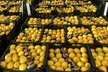
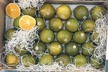
The harvest of Valencia oranges is currently in full swing in Laconia, the only region in Greece where this particular variety is grown. The work is intense and ongoing on a daily basis. According to Mr. Yannis Skevis, owner of the local export company Evrotas Gold, demand this year is strong enough to absorb the available volumes: "This year's production in Laconia is higher, but we are pleased with the level of demand. Both the domestic market and neighboring countries such as those in the Balkans, as well as Hungary, are buying a good amount of fruit."
 © Evrotas Gold
"On the other hand, demand from Italy has eased slightly in recent days, even though the issues we faced with sea transport toward that market have now been resolved," he adds. The season is developing smoothly overall, but as Mr. Skevis clarifies, it could have unfolded even better if a larger percentage of the fruit were of sizes 4 and above.
"This year, medium and small sizes—specifically sizes 5 through 8—are dominant in the calibration. Fortunately, Valencia is largely a juicing orange. This applies not only to the industrial juice sector but also to fresh-squeezed juice at home or in the food service industry. Therefore, the smaller sizes are not as problematic. We only sell to the fresh market, where we face competition from Egypt and, more recently, from South Africa. This has become a given in recent years. However, if we had more large-sized fruit, the season would have been even better. For example, Poland is asking for bigger oranges."
 © Evrotas Gold
Regarding pricing, the Greek exporter states that grower prices currently range between €0,40 and €0,50 per kilo, with larger, blemish-free fruit commanding even higher prices.
"It's the lack of water that has led to this widespread small sizing," he notes. "The same issue is expected to impact next season as well. "We pack all types of citrus year-round, but we are already seeing signs that the early varieties due in October will face problems due to water scarcity. Fruit set in Navelinas is not developing well, and we expect a reduced crop," Mr. Skevis concludes.
For more information:
Yannis Skevis
Evrotas Gold
Tel: +30 699 695 1236, +30 699 812 9009
Email: [email protected]
https://evrotasgold.gr/en/home/