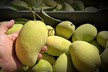
This mango season has been challenging for growers in Karnataka, particularly in Kolar district where harvest typically begins in the first or second week of May, says Ajay Rama, an agripreneur based in this region. According to him, the season had a late start towards the end of May, primarily due to delayed market openings and significantly lower prices.
Rama reports that overall production was up by about 30% compared to last year on his and neighboring farms. "Despite higher yields, quality suffered due to several weeks of rain just before harvest, leading to fungal attacks such as anthracnose, which caused lesions on leaves, stems and fruits. This increased wastage to about 25-30% this year, compared to 20% last year," he mentions, while adding that the main varieties grown in the region include Totapuri for processing and Banganapalli for the export and fresh market.
 © Aranya Fruit Forests
"Last year, Totapuri fetched between USD 0.23 to 0.35 per kg. This season, prices plummeted to USD 0.02 to 0.06 per kg, which is barely enough to cover the cost of harvest and transport. The total cost to grow and maintain mangoes is typically USD 0.09 to 0.12, so farmers were operating well below break-even," Rama explains. He attributes this drop to a late start by juice processing companies who buy up to 90% of the region's crop. "A sluggish export market caused by uncertainty over market rejections in the US, and high logistics costs also influenced pricing."
According to Rama, the bulk of Karnataka's mangoes, especially Totapuri, are not exported but consumed or processed locally, with only a small share exported directly by individual growers. "The dependence on local wholesale mandis or Agriculture Produce Market Committees (APMC) under the state government leaves most farmers vulnerable to price fluctuations and opaque trading practices," he shares.
 © Aranya Fruit Forests
The Karnataka state government did announce a minimum support price, but Rama explains that in reality, farmers are assured of only 0.05 USD per kg as support, applied at a rate of two tons per acre and capped at 10 tons per farmer. "This means a maximum of USD 460 to 475 per farmer owning five acres or more. However, the compensation has not yet reached many farmers, and when announced, mandi prices actually dropped further, reducing the benefit," he adds.
Looking ahead, Rama recommends the government should bring more transparency and efficiency to the current wholesale market system: "Direct support to farmers' accounts, and price incentives for higher quality produce are needed. Access to urban retail markets and a fair grading system could significantly improve farmer incomes. For now, the season will wind down by late July, with many growers left frustrated and hoping for more effective policy support next year," he concludes.
For more information:
Ajay Rama
Aranya Fruits Forests
Tel: +91 99 00 599 528
Email: [email protected]