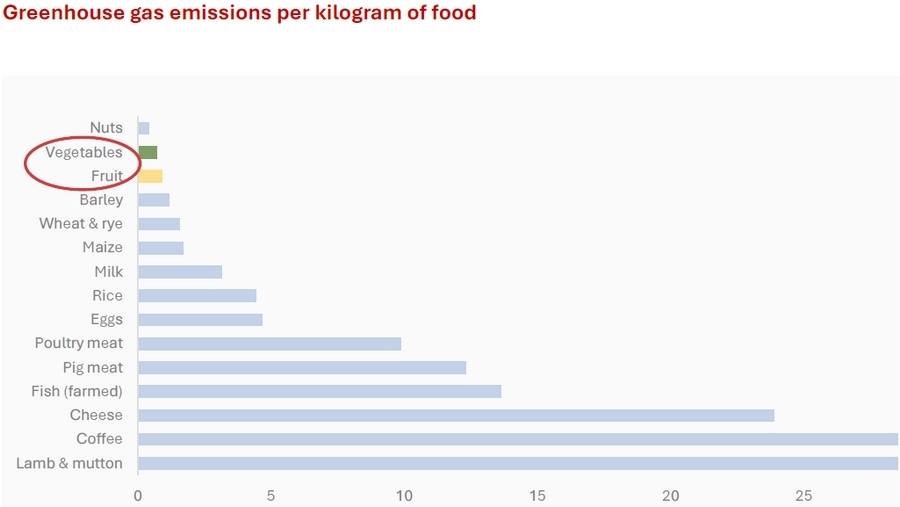
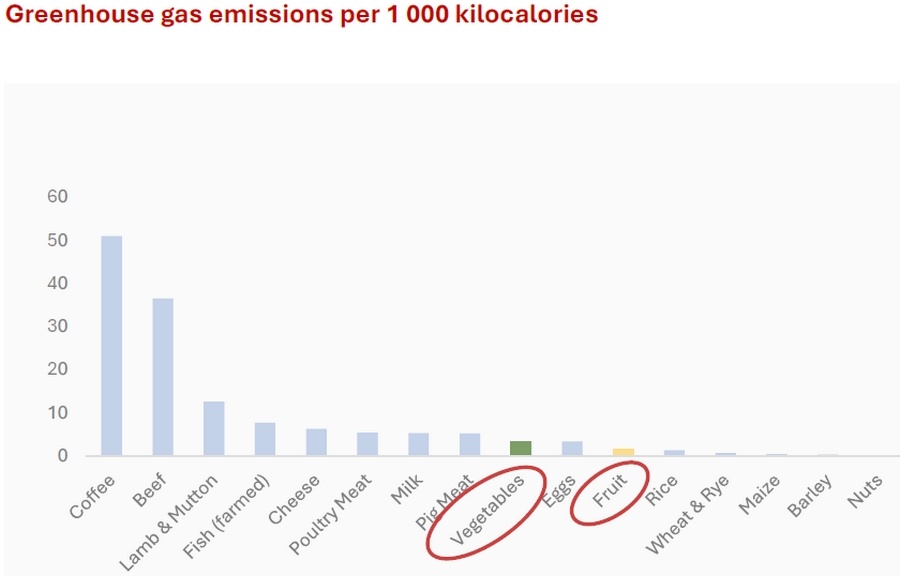
Fruits and vegetables play a central role in the push toward sustainable food systems. Not only are they essential for health and nutrition, but their environmental footprint is significantly lower than most other food categories. Compared to meat and dairy, which generate much higher levels of greenhouse gas emissions and require extensive land and water, fruits and vegetables are far more resource-efficient. For example, producing one kilogram of bananas emits just 0.9 kg of CO₂ equivalents, compared to nearly 100 kg for beef. Similarly, water usage for apples is about 180 liters per kilogram, far below the 1,796 liters needed for pork.
 © Global Coalition of Fresh Produce
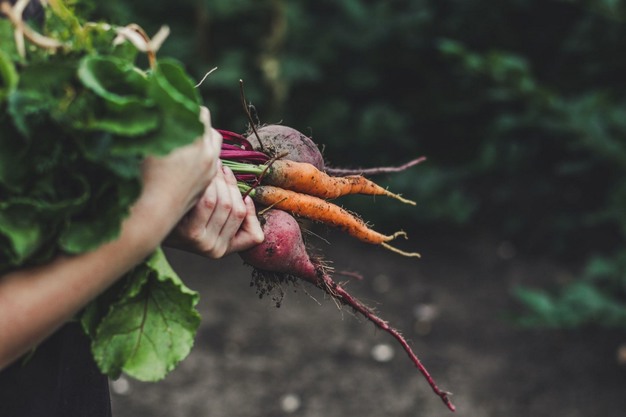
These plant-based foods are also mostly consumed with minimal processing, requiring fewer resources throughout the supply chain. Moreover, many fruit and vegetable crops actively contribute to environmental health. Perennial orchards, for instance, can sequester carbon, support biodiversity, and provide habitats for pollinators. Several farms and producers have also begun integrating renewable energy, precision irrigation, and organic practices to further lower their environmental impact.
The industry continues to develop innovations that reduce waste, limit chemical use, and improve resource efficiency. Examples include Lufa Farms in Canada, using hydroponic greenhouses and closed-loop water systems, and East African Growers in Kenya, which has implemented IoT-based irrigation for avocado crops. In Brazil, Agrícola Famosa uses seaweed biostimulants to regenerate soil health and boost resilience in extreme heat. These efforts show that fresh produce farms can lead the transition to climate-resilient, low-impact agriculture.
 © Global Coalition of Fresh Produce
Click to enlarge
While food loss remains a challenge across the supply chain, fresh produce supply chains are increasingly adopting solutions such as improved cold storage, packaging innovations, and digitized traceability to reduce waste and improve sustainability. In low-income countries, investments in better infrastructure for post-harvest handling are helping farmers preserve more of their harvest and reduce environmental loss.
 © Global Coalition of Fresh Produce
Click to enlarge
Despite calls to reduce "food miles," the report emphasizes that transport contributes only a small share of emissions in most cases. What matters more is how food is grown, not how far it travels. Supporting global trade in fruits and vegetables can also help sustain rural communities in developing nations without significantly raising the carbon footprint. International fruit and vegetable trade supports diversified diets, income for smallholder farmers, and year-round availability of nutritious food in regions that lack domestic production.
The fresh produce industry is uniquely positioned to help build a healthier planet. With its low environmental impact and growing list of sustainability practices, fruits and vegetables are key to a more resilient global food system.
To view the full report, click here.
 © Global Coalition of Fresh ProduceFor more information:
Global Coalition of Fresh Produce
Email: [email protected]
www.producecoalition.net