British Columbia blueberry growers are welcoming the long-awaited news of a $228-million joint relief fund to help B.C. farmers recover from the flooding in late 2021. The assistance program is a joint federal-provincial initiative and applications for funds opened on February 7th, 2022.
“Our ordeal started on November 15th and these have been some stressful few months, not knowing how we are going to clean up and restart our lives and revive our livelihood, the blueberry fields,” says Harry Sidhu, whose family farms in Sumas Prairie.
Over the next few days, the B.C. Blueberry Council based in Abbotsford, BC will review the fine print of the AgriRecovery program. It says once it has a better understanding of the program, it can determine if it adequately covers the losses of blueberry growers.
November’s flooding affected at least 2,500 acres of blueberries--though approximately 700-1000 acres were more severely impacted--largely affecting the Sumas Prairie region. In all, the province is home to more than 26,000 acres of highbush blueberries, an acreage that on average produces 165 million lbs. of blueberries a year.
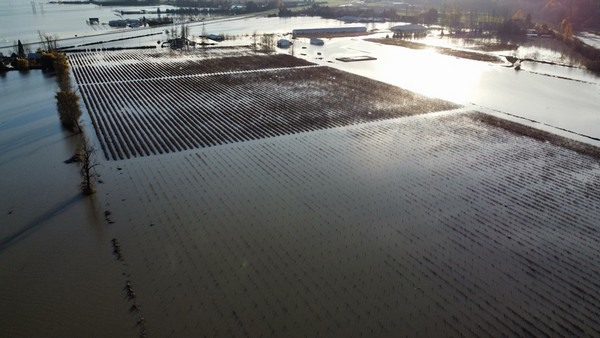 An impacted blueberry field in the Sumas Prairie area. Image submitted by a B.C. blueberry grower.
Regions affected
Blueberry growers in the region remain uncertain about not only how their plants made it through the event but also about the state of their machinery and farm structures. Growers in the Matsqui and Hatzic Flats areas are also concerned since their fields experienced significant flooding, and there was localized flooding in other blueberry growing regions in the lower mainland.
The blueberry fields in less flooded areas where the water drained after five to six days and was only two to three feet deep may have a chance to recover their fields, though it’s expected that all flooded blueberry fields are likely to experience varying degrees of damage or loss. “Damage to fields is starting to be reassessed now that the water has receded,” says Jason Smith, the B.C. Blueberry Council’s board chair. However, the industry won’t know the full impact of the event for at least a season or two given some of the effects might be more apparent over time.
“There is a strong possibility that severely impacted growers will need to pull out their plants and replant them, which could be a large financial expense,” says Sidhu. “Blueberries are a perennial plant, and it takes years for a sizeable crop yield, so this may be a significant loss of income for many years." For the replanted plants, it may take a minimum of five years to produce any meaningful volumes.
However, Smith notes that while the majority of the B.C. blueberry growing region is not impacted and there is no short or long-term impact for B.C. blueberry consumers, a proper crop outlook may not be available until the spring or early summer.
 For more information:
Clara Moran-Sakalauskas
B.C. Blueberry Council
Tel: +1 (604) 864 2117
[email protected]
https://gobluebc.ca/
https://www.bcblueberry.com/