"The season's start was a bit bumpy, harvest and weight-wise," says grower Niels Zuurbier of Ursem Zuurbier. This Dutch farm grows mainly iceberg lettuce. The cold, wet spring's to blame for that chaotic start. However, in early June, both iceberg lettuce cultivation and sales were going well, with satisfactory prices. Niels sells around 40% of his crop to processors. He sells the remaining 60% as fresh heads to supermarkets and wholesalers. These are in the Netherlands, France, Italy, the Czech Republic, and Eastern Europe.
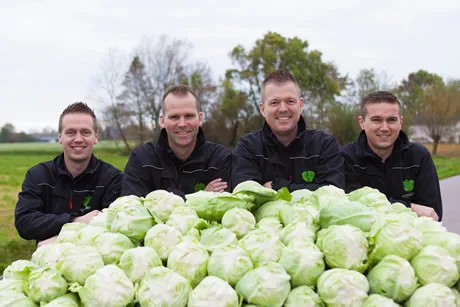
Niels (3rd from left) and his partners at Ursem Zuurbier
On par
Niels thinks this year, unlike last year, prices will remain on par. In 2020, the iceberg market suffered from the closure of the hospitality industry. "Last year, during the first lockdown, there was a run on supermarkets. But later, the hospitality industry closure hit us. That's because processes supply lots of fast-food chains. We lost sales there, which you have to try and recoup in the standard sales channel. That creates quite a supply-heavy market." So, he's happy that eateries can reopen and doesn't expect surpluses this season.
That's because there are fewer and fewer growers, of whom most make sales agreements. There are, therefore, few heads of iceberg lettuce cultivated for the free market. The iceberg lettuce market is, however, no longer growing and is becoming saturated. Niels thinks the various other types of lettuce available on the market and being consumed are causing this. That means it's vital that the iceberg grower consider new markets like Eastern Europe, in particular. "Food retail is still growing there, and we're seeing if there are any new opportunities."
15 million heads
Ursem Zuurbier specializes in iceberg lettuce. Annually, they harvest about 15 million heads on around 20 hectares. However, in the winter, the company also cultivates pointed and other cabbage varieties. They are exploring growing sweet, flat cabbage year-round too. This niche product is a type of cabbage originally cultivated in the Middle East. "We've been growing these for a few years now, and it's going well," explains Niels.
"It's similar to pointed cabbage, but then flat and much sweeter, with a nice soft structure. That makes it suitable for salads and wok dishes." Several supermarkets have added this variety to their ranges. It's, however, not easy to get shelf space for a new, large type of vegetable alongside other bulky Brassica varieties like cauliflower, pointed cabbage, or white cabbage. "It sometimes proves difficult to make space for a new product."
Challenges
Niels considers the shrinking pesticide range as the most significant challenge facing iceberg lettuce cultivation. He thinks reducing the number of permitted crop protection agents is the wrong way to reach sustainability. It increases the risk of crop failure, which can then lead to wastage. Zuurbier prefers that work be done on a single robust, sustainable cultivation system. It must combine the best aspects of conventional and organic farming, not separate them.
Requirements are becoming ever-stricter. Restrictions on possibilities have also created a paper reality, causing growers to become less driven. Ursem Zuurbier has abandoned restrictive organic cultivation and focuses instead on making cultivation more sustainable. Things like increased crop rotation and using catchment crops come into play here. "We farm a lot along with crop farmers and bulb growers."
"That's to keep the pressure on the land as low as possible. We try to manage our cultivation as sustainably as possible." The climate is changing too. Ursem Zuurbier irrigates when needed. It's also becoming windier, causing the sandy soils to drift. That's potentially damaging to iceberg lettuce. "We prepare for the windy periods by covering the fields with a thin paper layer. That keeps the lettuce in place. This layer disintegrates after a while," concludes Niels.
Niels Zuurbier
Ursem – Zuurbier C.V.
Donkereweg 6a
1704 DV Heerhugowaard
+31 6 5474 1523
[email protected]
www.ursemzuurbier.nl