Transformation to healthy diets by 2050 is going to require substantial dietary shifts, and the doubling the consumption of fruit, vegetables, nuts and legumes, according to AUSVEG.
AUSVEG is one of the stakeholders of the joint industry conference and trade show, Hort Connections 2019, and CEO James Whitehead is confident that for all the future opportunities in agriculture, it will be horticulture that people will turn to more significantly. That means there will be many areas for growth for fruit and vegetable growers across Australia, through making effective changes.
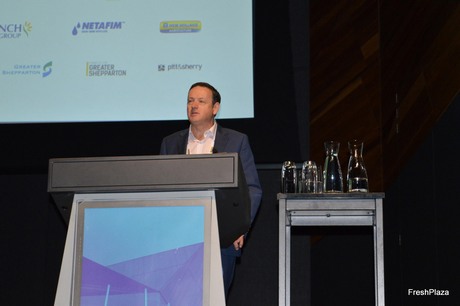
"Of course, there's climate change and everything else environmental and sustainability, but also rapidly changing consumer sentiment and power," he said. "It is going to be interesting to see who takes these opportunities first. How will our food be grown in the future? How and where will the capital be employed to make these changes? What will a successful family farm look like? There will be a relentless wave of social and environmental drivers that will push consumers our way. These are the opportunities that we need to be preparing ourselves for."
The advocacy organisation represents vegetable and potato growers in Australia, which produce over $3billion collectively, but Mr Whitehead says it is only a third of the sector, and would like to see a more unified horticulture approach to representation.
"We need to develop a stronger collective advocacy capability," he said. "We trip over ourselves too much, there is too much duplicated effort and we waste too much time and money and it is not acceptable and results are sub-optimal. We (AUSVEG) are the biggest group, so the problem for other groups is even bigger. So, to grab its potential, grab the opportunities that the future holds, this is one area where we need to lift our game. One option may be the one that operates in New Zealand. There is one group, Hort NZ, that manages all of the industry-wide advocacy issues. They do it once, and do it well."
He also welcomed the re-election of the coalition government, saying it provides a more certain political landscape, and the opportunity to influence change more effectively.
"Firstly, we need to ensure that we understand the most important issues that growers seek our support on," Mr Whitehead said. "These are almost always a combination of labour supply, biosecurity management and cost-related issues - labour, energy and the most complex of all - water."
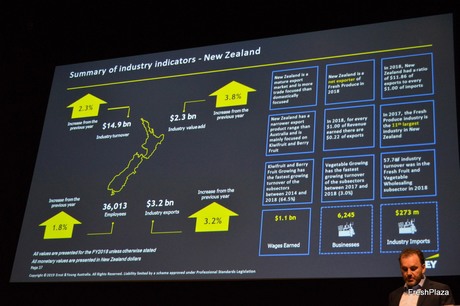
Darren Keating from the other joint stakeholder, PMA Australia-New Zealand Limited, presented findings the organisation's State of the Industry report. He says the aim was to capture the whole supply chain, admitting that it was "heavy" in the amount of data and trends that it contained.
"The first thing to note is the size of the industry; it's big, and valued at $45.9billion from farm gate through to retail," he said. "To put this in perspective, fresh produce is Australia's 16th largest industry - larger than the arts and recreation services, and around the same size as education and training. One of the key take home messages that I see is that we have only had modest growth and turnover in past five years."
He highlighted three "mega-trends" that are sitting over the industry; globalisation, demographics and technology, which come from a number of drivers such as artificial intelligence, robotics, urbanisation, the aging population, millennial workforce and social media.
"These drivers are disrupting the industry, and are anticipated to continue disrupting the future," Mr Keating said. "Changes have occurred quickly and are anticipated to grow exponentially over the next decade. The rise of snacking vegetables, home delivery services, meal preparation kits and superfoods in the consumer market shows a desire for high-quality fresh produce to be conveniently packaged for the time-poor consumer. Businesses have shown that an increase in the adoption of technology including robotics, blockchain and software to create leaner supply chains, reduce cost and provide tailored products and experiences to consumers."
Mr Keating added that the increasing need for data is going to mean that producers are going to have to become more efficient and smarter in the way that they collect and share it.
"Consumers expect to be understood and catered for," he said. "They value transparency, value service over product and have low-brand loyalty and price sensitivity. (They want) a resourceful planet; this is a clear message on sustainability and preserving the environment. I don't think this trend is going to go away, and our industry discussions on packaging and waste are clear indicators that this is here. Social media has changed the way the whole world communicates, including how consumers behave and has resulted in a 24/7 online presence. But just being there isn't always a good thing - you need to have an appropriate strategy. Then there's health. Everyone talks about it being an opportunity, but I think it's the golden one that we are all missing. The fitness industry is worth $2.5billion in Australia. We are not seeing that growth in the fresh produce industry. It will be the area to watch - but we need to go beyond simply saying 'eat your greens'."
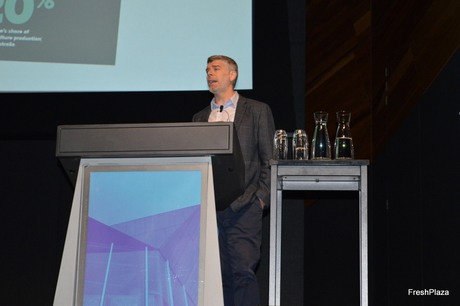
CEO of Hort Innovation Matt Brand told the conference that the organisation has come up with a new vision; to drive a prosperous Australia by "providing the best knowledge and solutions, to create a world class hort industry". After a tour of the country, to get feedback from growers, it established a new extension and adoption team.
"We need to take more ownership of driving knowledge, through communication and extension mechanisms," he said. "(The new team will) help amplify all that work that we have done and are doing with service providers, government agencies and industry bodies. We also need to drive a better understanding to the consumer in all key markets here and overseas - without a consumer, we don't have an industry. We need to divert more money to invest in multi-industry projects, and we need to find a better way of receiving advice. But most of all, we need to engage more at grassroots level; with innovative farmers, active regional groups and anywhere growers gather."
Mr Brand broke the organisation's way forward down into two "imperatives". The first is driving knowledge and innovation in the horticulture industry, which will lead to communication and extension that impacts business decisions and practices on farm. The second is driving the highest value research and development, trade and marketing investments across industries.
He added that Hort Innovation has seen a 22 per cent annual growth in exports over the past five years, and its trade team will continue to help overseas markets become a reality, particularly in Asia. While sustainability has become an important issue for the industry to overcome in recent years.
"It's about creating long-term stakeholder value - economically, socially and environmentally," Mr Brand said. "We will be working with all of industry to develop a baseline measure of our performance against community expectations across those three areas. Then we undertake research on an ongoing basis to really understand community attitudes and how the sector's current performance sits in line with those expectations, and where industry attention may need to be delivered."
The “PMA A-NZ Fresh Produce Industry: State of the Industry Report 2019” can be found here: https://www.pma.com/Global-PMA/ANZ/News/2019/State-of-the-Industry-2019