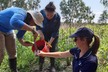
The Local Development Institute (IDL) is a research group of the University of Huelva (UHU) that has studied an essential aspect of this province's agriculture very closely: the migratory flows motivated by the willingness to participate in the different campaigns. The work carried out by the IDL has aroused interest both inside and outside the country.
The latest example of this is the visit of a representative of the Ministry of Labour of South Korea, who was interviewed by the researcher Mercedes Gordo Márquez, a professor at the University of Huelva, who is currently on political leave.
Under the direction of Juan Márquez, Mercedes Gordo has studied the development of the model applied in Huelva, which has aimed to adequately meet the demands of entrepreneurs while protecting the dignity of the workers. The visit of the Korean delegation to Huelva is explained by the fact that "they have labour issues and are looking for models that they can adapt in order to address the problems arising in their agricultural campaigns," while always taking into account that "the Huelva model is very unique," explains Gordo.
The South Korean Ministry contacted the researchers from Huelva through a Polish colleague who works in the United States and was already aware of what is being done in Huelva. The Korean delegation had previously visited Italy before arriving in Spain.
While in Spain, they also met with the Immigration Secretariat of the Ministry of Labour and the head of the Labour Sub-delegation of the Government in Huelva, who took them on a visit to some farms and cooperatives. The Koreans then went to Norway in order to learn how they manage their labour needs there.
The Korean delegation that visited Huelva belongs to the Foreign Work Force Office of the Human Resources Development Service of the Ministry of Labour of that republic.
One of the strong points of the Huelva model, according to the studies of the Local Development Institute, is that "an Aliens Law was introduced." The model ensures that the workforce arrives depending on the demand of the companies, with the workers being offered training, housing and even the cost of travel from their country of origin, which at the moment is Morocco.
It is also a flexible model, since, as added by Mercedes Gordo, adapts to the needs of the sector and the overall situation of the country's economy, so that "in times of crisis, quotas are reduced to be able to make use of local labourers, since the Aliens Law indicates that priority must be given to the latter."
The UHU professor commented that "the Korean delegation was interested in aspects such as the calculation of what should be the necessary quota of foreign labour, housing conditions, how to articulate the return to their country, if work is done to facilitate their integration, etc."
The program implemented in Huelva is dynamic and is undergoing certain changes that will have to be addressed. Thus, in 2015, "the IDL published a report in which it was shown that the campaigns are becoming increasingly longer, while other crops besides strawberries are also expanding. This is the case of blueberries and other berries that are gaining ground in Huelva's fields."
Furthermore, it is necessary to take into account that the strawberry sector increasingly needs more labourers, which in some cases makes it necessary to resort to workers not officially involved in the process; hence why camps arise in some areas of the province, with immigrants who wait to be called, even sporadically, to work in the fields.
The Aliens Law, however, calls for the hiring of foreign employees to be carried out in countries with which there is a prior agreement. In this sense, we have worked with Poland, Bulgaria, Morocco and some Latin American countries. The entry of Poland and Bulgaria into the European Union gave their workers another type of guarantee as EU citizens, so the hiring today is exclusively done with Moroccan workers for a maximum of nine months and a minimum of two or three months.
Huelva's system, which had its beginnings in the Lleida campaigns of 1999 for which an agreement was signed with Colombia, also applies to other crops, such as oranges, also very popular in the province of Huelva. It governs the harvesting of the strawberries, as well as the plantation when there are not crises and more resources are available for the hiring of foreign workers.
The reality of Huelva is unlike that of other places in Andalusia. The most obvious example of an agricultural producer is Almeria, but in this case, the system is not feasible, since the campaigns are spread out throughout the year, so the workers are not as seasonal. For its part, Huelva's case perfectly meets the requirements stipulated by the Aliens Law.
Source: huelvainformacion.es