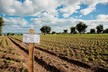
In the municipality of Elche, March is a key month for producers of vegetables like broccoli and cauliflower, but things won't be as good in 2017 as in previous years. The reason is simple: growers in this area and in the Vega Baja have not been able to plant these two vegetables for a month because of the soil's high humidity, caused by the storms that hit the province a couple of weeks ago and last December.
The president of the Agrarian Association of Young Producers (Asaja) of Elche, Pedro Valero, explains that both vegetables are planted approximately every ten days between August and late February.
The growth of both broccoli and cauliflower lasts between three and four months, depending on the variety, so with almost nothing having been planted in January, in March there will be a gap in the cycle. This is an important month because, according to the growers, it is when these vegetables are scarce elsewhere in Spain and sales rebound in the south of the province of Alicante. However, Pedro Valero does not believe that there will be too many economic losses in a winter campaign in which they already estimate the broccoli and cauliflower production to fall by about 8% compared to the previous season. "Also, the product being brought to market is of good quality and is being paid at a good price," states the producer.
For his part, the representative for the south of Alicante of the Unió de Llauradors, Juan Miguel Montaner, noted that "these vegetables are not the best we have obtained in recent years, because, due to the humidity, they have suffered the impact of botrytis; a fungus that causes spots to appear. However, although they may not be the highest quality pieces, they dominate in a market without competition, due to the fact that in other areas of Spain where these types of vegetables are grown, the weather has been much rougher. "Although both representatives differ minimally as to the quality of the product, both share the idea that the market situation is favourable for Elche's producers.
According to the growers, not only are there good prospects at domestic level, but also internationally; specifically in northern Europe, where, according to the president of Asaja in Elche, there is much demand this year. "There, too, the has weather taken a toll, so they are demanding a lot of product," he says.
Overall, this winter campaign Elche expects to harvest 3.1 million kilos of cauliflower and 3.1 of broccoli, as well as almost 14 million kilos of artichokes, which have also been hit by the cold, 1.6 million kilos of potatoes and 1.2 million kilos of beans.
Pedro Valero concludes that, in general terms, most vegetables will record lower production volumes, but a higher demand; therefore, prices will increase. "Also remarkable is the saving in irrigation costs thanks to the two storms," he affirms.