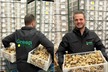
Jean Claude Mathaly was devoted to logistics and to the distribution of organic agricultural products in France when he realised that in spring, when the harvest was over, French consumers were left without organic carrots. With the idea of filling this gap, he travelled to Andalusia in the early 1990's looking for land with the right climate to grow organic vegetables. He settled in Cadiz, in San José de Malcocinado, a small district of Medina Sidonia, where he founded El Cortijo Bio in 1992. He started with five hectares and currently has more than 600 in La Janda, Sanlúcar de Barrameda, Jerez de The Frontera and Los Palacios, in Seville.
This pioneer of 'bio' cultivation in Spain was initially specialised in carrots, and over time the range was expanded with other products, such as beet, pumpkin, potato, leek, onion or sweet potato. The latter has become very fashionable and El Cortijo Bio is the only Spanish company that has launched a specific line and technique to produce sweet potatoes and is able to supply them all year round.
A new project from Jean Claude Mathaly is to launch the production of tropical crops, specifically avocados and mangoes.
The turnover of El Cortijo Bio is mostly generated from exports, with sales standing at 15 million Euro and annual growth reaching 10%. Around 95% of the sales are made overseas, mainly to Germany (40%), France (25%), the United Kingdom (15%) and other destinations, such as Belgium, the Nordic countries, Switzerland and Portugal.
"The Spanish market is not comparable to that of central and northern Europe, but there is still no strong awareness about organic products. Germany or France are miles ahead of us, although in recent times there has been some progress in the domestic market," explains Araceli Gloria, the company's commercial director. "The crisis is being left behind and this is helping boost consumption, since during the recession, prices have been the main factor," he stresses.
During the peak export period of the campaign, between March and June, the Cadiz-based company employs up to 500 people; a labour force that is mostly recruited in the towns of the region. The firm also packages and distributes its organic vegetables, which are grown without using pesticides or chemicals. Its facilities are equipped with refrigeration systems and specific lines for each product, allowing it to have full control of the production, storage and marketing stages.
Source: diariosur.es