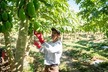
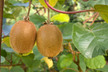
Tropical fruits and vegetables like mangoes, papaya, carambola and dragon fruit, may soon become commonplace crops in a rather unlikely location - South Korea.
Korean agricultural researchers are experimenting with new tropical crops that could grow well under hotter weather conditions on the Korean Peninsula as a result of the global climate change that is driving up the earth’s temperature year-by-year.
At the heart of such efforts is the state-run Research Institute of Climate Change and Agriculture, located on the southern resort island of Jejudo.
“We are investigating how climate change could hurt the competitiveness of Korea’s current stronghold crops, as well as considering which tropical fruits could be successfully grown and cultivated here in the future,” the institute’s director Seo Hyeong-ho told reporters on Jejudo.
The institute is currently cultivating 42 tropical plants and vegetables at its on-site greenhouses to determine which crops could be the most profitable in the future in terms of the cultivation process, costs and market value.
One indoor orchard houses the well-known apple mango, a fruit some Jejudo farmers have already commercialised, while others house more unfamiliar tropical vegetables such as the long-shaped snake cucumber, the star-shaped carambola and the chayote squash, among others.
“Most of the tropical fruits and vegetables under research here come from Southeast Asia as well as parts of Central America,” said an institute official who oversees the greenhouses.
“When Korea’s tropical plants business takes off, local customers will be able to purchase locally grown tropical fruits and vegetables that are fresher and cheaper than their imported counterparts,” he said.
Over the past 100 years, Korea’s average temperature has risen by about 1.8 degrees Celsius, at a rate roughly 2.4 times faster than the Earth’s average, the institute said.
The warmer weather conditions have already prompted many Jejudo farmers to switch their main crops from mandarin oranges to more tropical fruits such as kiwis and hallabong oranges over recent years, according to the Rural Development Administration.
Source: koreaherald.com