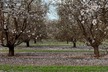
Cereals, fruit, olives or feed have been discarded in favour of pistachios, the chosen crop looking to break into the agricultural landscape of Lleida's plains. The Catalan Government is encouraging growers in the province of Lleida to introduce pistachio, promoting it as an alternative with great potential for the irrigable area of the Segarra-Garrigues canal because of its high yield and resistance to extreme temperatures.
The production of pistachios, whose price (in shell) ranges between five and nine Euro per kilo, could alleviate some of the problems faced by growers due to the considerable drop in prices, especially for sweet fruit. But this crop also has drawbacks: it needs a lot of water and the tree does not bear fruit four for years after being planted.
The International Borges Group, owned by the Pont family, has planted the first 16 hectares of pistachio trees in Mas de Colom de Tárrega, next to a former Cistercian monastery, that will be irrigated with water from the Segarra-Garrigues canal. The company's goal is to expand the acreage to 50 hectares. Borges, which already has pistachio plantations in Badajoz, Granada and California, has also signed an agreement with the Department of Agriculture and will provide technical advice and soft loans to future producers, from whom it will buy the production.
Pistachios need much water and take ten years to be profitable
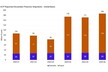
Ramón Pont, president of the firm, predicts a dramatic growth for pistachios, similar to that experienced in the United States, where in 30 years its production has multiplied almost by twenty, going from 12,338 to 235,000 tonnes, thus becoming one of the world's major producing countries (next to Iran, Turkey and Syria). Spain, with only 5,000 hectares planted, has to import about 14,000 tonnes every year, so the nut's cultivation has a guaranteed market simply considering the domestic demand.
Antoni Pujol, coordinator for pistachio promotion at Borges, says that the introduction of pistachios on irrigated land has sparked great interest from growers in Lleida, despite the complexity involved for them in the switch to the crop. Besides good production prospects (between 2,500 and 3,500 kilos per hectare) and marketing, Pujol lists the advantages of pistachios over other major crops in the area, including sweet fruits. One is the tree's productive longevity, over 50 years, as well as the low production costs, pest resistance, easy mechanisation (similar to olives) and late flowering (from the second half of April), which makes it resistant to extreme temperatures.
The growers interested are afraid to invest without public aid
One of the main drawbacks, apart from the difficulties involved in finding affordable grafted plants, is the long process necessary before the pistachio trees become productive, which only start bearing fruit after they have been planted for four years and reach their peak from the seventh or eighth year. Furthermore, reaching a high production requires 4,000 cubic metres of water per hectare.
The pistachio is a dioecious tree, with abundant branching and a broad crown. One peculiarity is its sexual differentiation, so that plantations require a strategic combination of male and female trees in the proportion of one to eight, to get a good pollination. Only female plants bear fruit.
Antoni Baldomà, who cultivates 40 hectares of cereals and fruit, is one of the growers in the area who has shown his interest in the new crop, although he is cautious. Like many other producers, he's afraid to make another investment without having yet amortised those made previously. "I find the idea attractive, but the fact that plantations are not profitable until after ten years is making me think hard before venturing," he points out.
Source: EL PAÍS