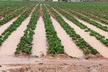
According to Coldiretti Lumbardy, the failed agreement on prices (with proposals ranging from €80 to 85/ton, insufficient to cover even production costs) together with the bad weather of the last few weeks making land unworkable and sowing impossible, will lead to a 15% cut on the next tomato harvest.
"Even if the weather changes, we won't be able to enter the fields until the 15th of April, with heavy delays on the whole production. If we add production costs to that, which have increased by 30% in a single year, and the fact that industries are talking about prices for 2013 that would lead to us working at a loss, it is easy to see how harvesting is going to be reduced by 15-20% this year," explains Paolo Voltini, chairman of the Casalasco Consortium (Lumbardy), which gathers 300 producers on 4,000 hectares.
In 2009, production was of 5.7 million tons, in 2011 it dropped to 4.95 million tons and last year it dropped once again to 4.5 million in five years, this sector lost more than 1.2 million tons of produce.
A few days prior to the start of sowing, even Emilia-Romagna's Cia (Confederation of Italian Farmers) is worried, as after many meetings between Producer's Organisations and the processing industry "there are still no proposals that grant growers a price that would cover production costs."
The tomato sector has just come out of the tragic year of 2012, when the weather conditions of some areas in Northern Italy compromised part of the harvest and therefore the profitability of crops.
Associations have witnessed disastrous years and handlers struggle to define a fair price, also because of the general crisis.
"An agreement must be reached, which takes into consideration production costs, in order to avoid the abandonment of tomato crops, which create a lot of work."
Last year, the price had been fixed at €84/ton, with a chart of all variations according to quality. "Because of bad weather, production has been penalised as well as growers, who made on average €76/ton, an amount considerably lower than the actual production costs. This year, we are expecting a more profitable price, otherwise there won't be an agreement."
In the meantime, a further meeting has taken place between the parties to decide a reference price for Northern Italy. Especially in Lumbardy, Emilia-Romagna and Veneto, this year cultivated surfaces shouldn't be more than 30,000 hectares, more than 50% of the national total.
More than 8,000 entrepreneurs and 178 processing companies, employing 20,000 people, work in the industry tomato sector, with sales proceeds of over 2 billion Euros.