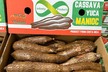
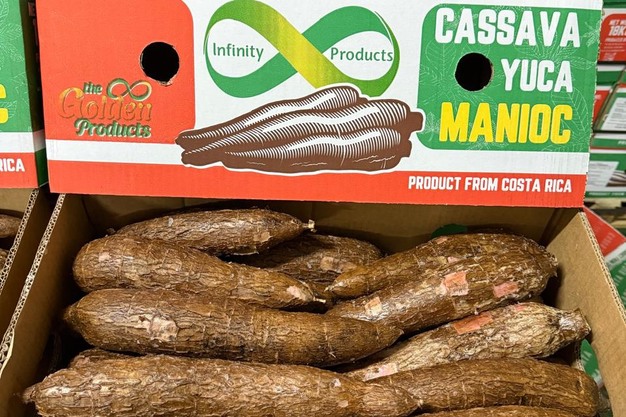
Like every Costa Rican cassava exporter shipping to Europe, The Golden Products is having to adapt to a regulatory change around waxing. Paraffin coatings—the industry standard for decades—are being gradually phased out for products destined for the EU. Natural wax is the new, more sustainable option and one that aligns with European Union requirements.
The company will run two processing lines in parallel: one using paraffin, which remains the standard for shipments to the United States and the Caribbean, and one using natural wax for Europe. The cost difference comes to roughly two dollars per box.
 © The Golden Products
"It's more expensive, but we have to meet the customer's expectations," says Diego Morera, one of the three co-founders and currently the company's managing director. "We're in a transition phase. In a few weeks, we'll be shipping with natural wax."
From scratch to growers, packers, and exporters
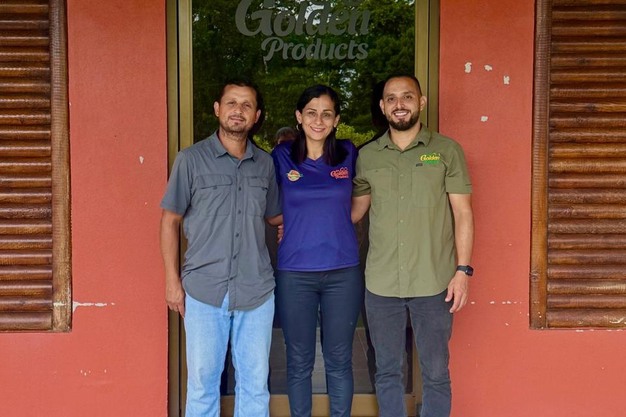
The Golden Products was founded in 2013 by three friends: Marlon, Andrea, and Diego. The beginnings were about as modest as you can imagine. "We had nothing, no money, no resources. Just the knowledge and the opportunity to build something." What they did have was the trust of those around them. Around twenty people and businesses extended them credit—for packaging, for product, for working capital—based on nothing more than faith in their potential.
 © The Golden Products
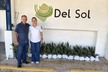
Marlon, Andrea, and Diego, the founders of The Golden Products
"That's one of the most beautiful parts of our story," says Diego. "That so many people saw what we could become and believed in us."
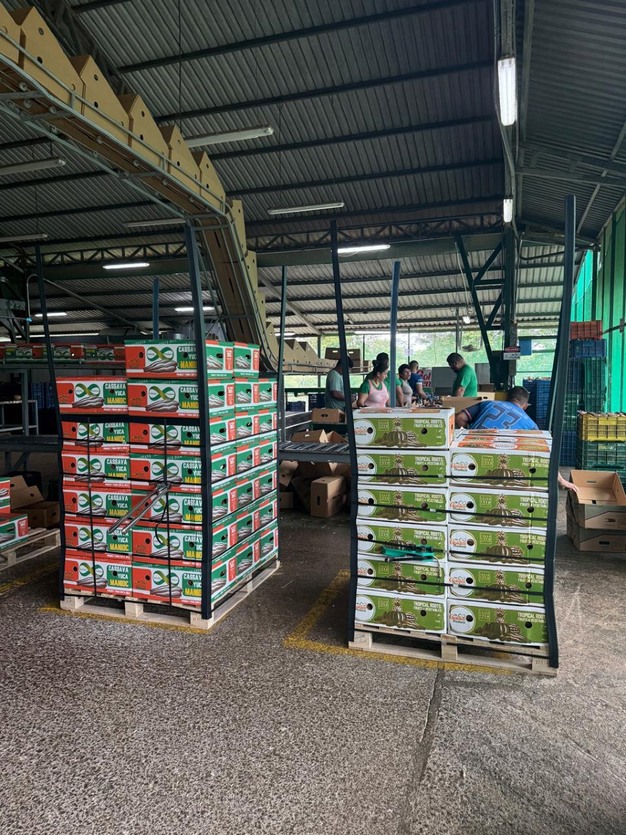
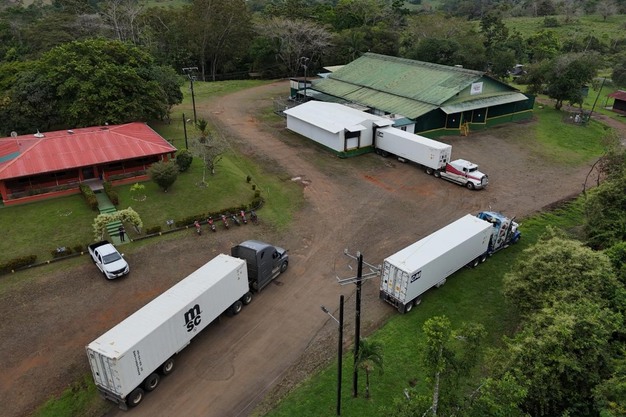
The company started out as a pure trading operation, buying from packing companies and selling into distribution markets. In 2016, it moved into farming, and three years ago it acquired its current farm and built its own packinghouse. Today, The Golden Products is a fully integrated operation: it grows, packs, and exports. "We control the whole chain," Diego sums up. He was 19 when they started. He's 37 now.
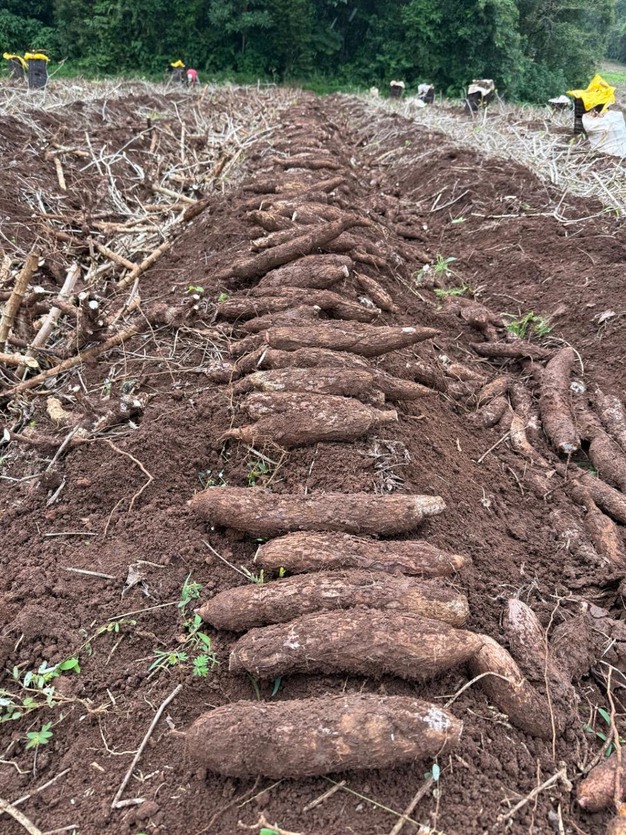
The flagship product at The Golden Products remains cassava, complemented by yam, squash, taro, ginger, and chayote, along with smaller volumes of carrot and cabbage. Production spans three regions of Costa Rica: San Carlos, Guápiles, and Cartago.
Volumes and markets
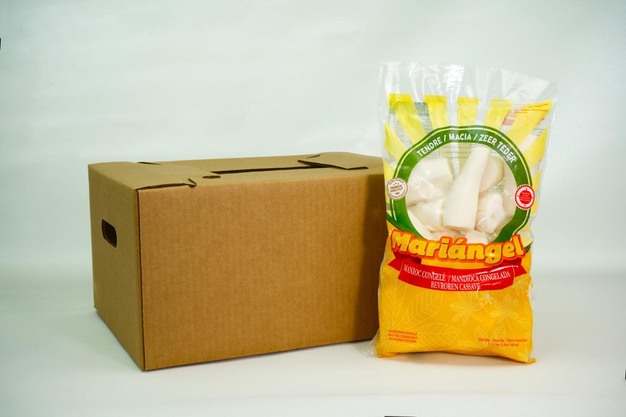
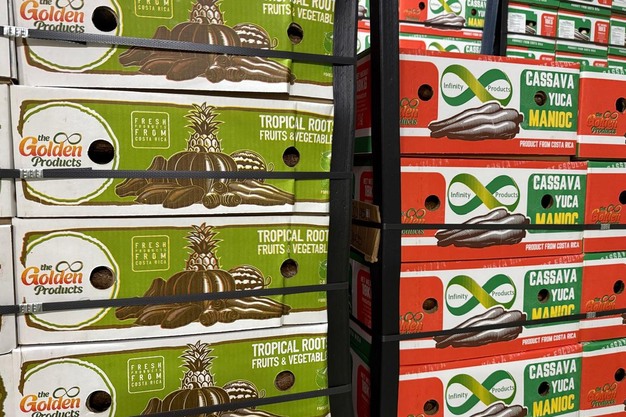
The Golden Products farms around 100 hectares of its own land and works with external growers covering more than 200 additional hectares. Fresh exports run to roughly 300 containers a year. A frozen line, sold under the Mariángel brand and including cassava, adds around 15 containers a year, destined for the United States and France.
 © The Golden Products
Frozen cassava under the Mariángel brand
Markets are split roughly evenly between North America—the United States and the Caribbean islands—and Europe, a balance that is no accident but the result of a strategic decision made in 2018. "For us, it's essential to keep volume steady throughout the year, because we have a packinghouse that can't afford to stop," Diego explains.
In the United States, the company is present in Florida, New York, Texas, and California, with different box weights and specifications depending on the market. In Europe, the main destinations are Spain, the Netherlands, and France. In Spain, The Golden Products supplies the country's largest distributor directly. For the Caribbean, its specialty is mixed containers—combined, smaller loads designed for island markets that don't need full shipments of a single product.
 © The Golden Products
 © The Golden Products
The company has 30 direct employees. More than 500 people—external farmers and their families—depend on it indirectly.
The company currently holds GlobalG.A.P. certification. Next on the agenda are Grasp and Essential Costa Rica, to be followed by SMETA, a social compliance audit increasingly required by major European supermarkets and U.S. chains such as Walmart.
Rethinking the land: a five-year transformation
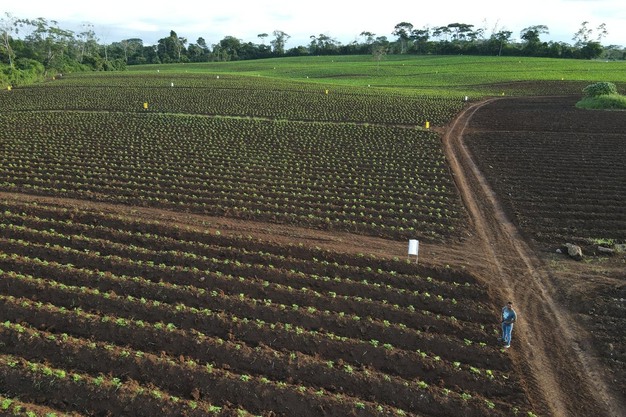
Seven years ago, Diego struck up a friendship with a graduate of EARTH University, one of Costa Rica's most prestigious agronomic institutions. "He told me about a new technology, and we started applying it gradually, with excellent results." That technology is biological agriculture: replacing synthetic chemicals with bacteria, fungi, and fermented liquid biofertilizers, known locally as bioles.
 © The Golden Products
Rather than applying fungicides directly to the soil, The Golden Products uses Trichoderma, a naturally occurring fungus that fights harmful soil fungi without the chemical burden. The philosophy isn't organic farming in the strict sense, but something more pragmatic: the responsible use of approved chemical products combined with biological alternatives, with long-term soil health as a non-negotiable goal.
"You have to remember that soil is an ecosystem. You have to look after it," says Diego. "Cassava grows underground, not in the open air like bananas or pineapples. This isn't a conventional business like pineapple or watermelon. It's different."
Over the past five years, this approach has driven a 30 per cent increase in yield per hectare. The company has built its own laboratory to cultivate Trichoderma and a biofactory to produce its own bioles and organic fertilizers. A 40-hectare pilot applying the biological method across the board now serves as a demonstration farm for external growers.
 © The Golden Products
From 200 litres to 20–30: the leap to drones
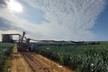
A single figure captures the scale of the shift The Golden Products has made in how it treats its fields. Conventional cannon spraying equipment uses 200 liters of water per hectare. Drones achieve the same coverage with just 20. "That's remarkable," says Diego. The move to drones also helps address a growing challenge: the difficulty of finding agricultural labor. "This year, we started doing all our applications by drone."
 © The Golden Products
"Technology," Diego says, "isn't the challenge. The challenge is convincing farmers with decades of experience to do things differently. To build a house, you need money and three months. To change a mindset, you need time: constant explanations and ongoing training." His answer isn't persuasion; it's demonstration. "The only way is results. That's why we set up The Golden Products agricultural unit: to help our growers improve their harvests."
 For more information:
Diego Morera (co-founder)
The Golden Products
Santa Rosa de Pocosol
Alajuela, Costa Rica
Tel.: +506 8819 4303
[email protected]
www.thegoldenproducts.com