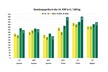
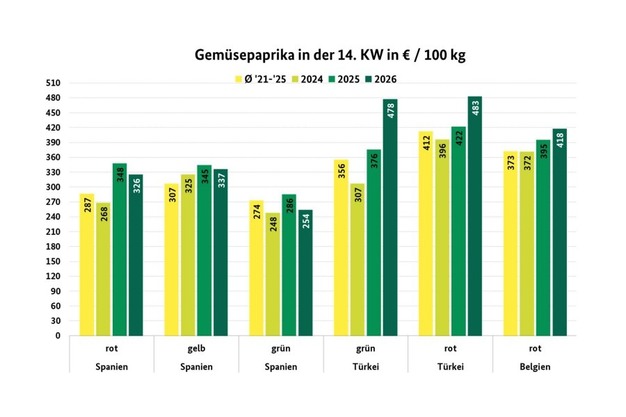
Spanish supplies still dominated the market, but their quality left something to be desired in some places, resulting in a wide price range. Availability had decreased slightly, as the end of the season is already in sight. However, a supply gap generally did not arise, as the presence of Dutch and Belgian loads had expanded. In addition, some Moroccan imports were available in Munich. And, of course, Turkish loads were also part of the market: occasionally somewhat scarce, the items became pricier; in Frankfurt, for example, one had to pay up to €2.45 per 400-gram bag.
 © BLE
© BLE
According to the German BLE, prices for Spanish, Dutch, and Belgian products often trended downward, though they were also higher on some days, which led to noticeable buyer hesitation in Hamburg. In Munich, retailers attempted to reduce inventories of Spanish products by offering discounts. Red domestic pointed peppers cost €8.00 and block peppers €7.00 per kg in Frankfurt. In Munich, the German season kicked off with the first green pods.
Click here for the full market and price report.
Apples
In addition to the dominant domestic loads, Italian deliveries were the primary supply. Shipments from France followed in terms of volume. Supplies from the Netherlands, Belgium, Poland, and Austria were supplementary. Overall availability had decreased slightly.
Pears
South African imports now dominated the market: Williams Christ, Cheeky, and Rosemarie formed the core, with Packham's Triumph, Abate Fetel, and Carmen serving as supplements. Overseas shipments also included Chilean and Peruvian Abate Fetel pears as well as Chinese Nashi pears. Availability expanded, and organoleptic qualities had also improved.
Table Grapes
South African shipments dominated by a wide margin over Peruvian and Chilean imports. Indian shipments were only sporadically available as a supplement: Thompson Seedless grapes in Frankfurt were still too small and cost between €16.00 and €16.50 per 4.5-kg box. Demand had declined in some areas due to the Easter holidays.
Lemons
Spanish Primofiori dominated the market and were available almost exclusively in some cases. In these instances, prices remained steady or rose slightly. The South African season began with the first shipments of Eureka, which cost €33.50 per 113-piece carton in Frankfurt and Hamburg.
Bananas
Demand was generally quite favorable. It had picked up in some areas; only in Munich was demand slightly weaker than before. Prices mostly remained at the previous week's level. In Munich, customers had to pay a bit more for the full range of products.
Cauliflower
Italian shipments dominated the market ahead of French and Spanish ones. Domestic, Dutch, and Belgian supplies supplemented the market. Although availability had increased, it remained tight overall, meaning demand could not always be met. Prices showed an upward trend.
Lettuce
Belgian and Italian loads dominated the market for cabbage lettuce, while domestic supplies played only a minor role. For mixed leaf lettuce, Italian, French, domestic, and a few Belgian loads were available. In both categories, the availability of German products had increased.
Cucumbers
The assortment of cucumbers consisted of Dutch, Belgian, and domestic loads, which collectively held roughly equal market shares. Deliveries from Spain, which had previously dominated the market, now played only a very minor role in isolated instances. Demand was quite favorable.
Tomatoes
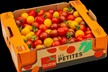
Spanish loads predominated over Dutch, Belgian, and Turkish ones. In addition, Italian, Moroccan, and Tunisian offerings were part of the market. A few domestic, costly items were primarily of interest to specialty retailers.
Asparagus
In the white and purple asparagus segment, German, Greek, Dutch, and Italian offerings were available. Holy Week improved supply conditions, and demand accelerated, particularly ahead of the weekend. Prices trended downward in Munich and Frankfurt, while in Berlin, customers had to pay slightly more due to high volumes.
Source: BLE