For many growers, Rabbiteye blueberries come with baggage. Stories of soft fruit, bland flavor, gritty seeds and rain split have followed the species for decades. In many regions, that reputation alone has been enough to take Rabbiteyes off the table entirely.
Oregon Blueberry believed the problem was not the species, but the genetics.
"Those criticisms were fair for older varieties," said Jon Horton, Director of Genetics at Oregon Blueberry. "But they also caused growers to overlook what Rabbiteyes do exceptionally well. Our goal with Raptor was to keep the toughness and efficiency growers rely on, and finally deliver fruit quality that meets today's expectations."
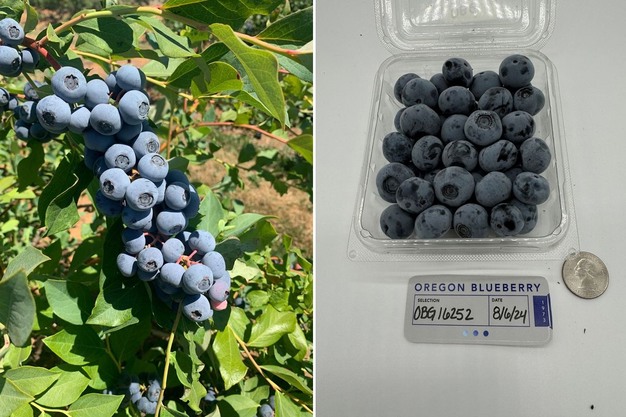
The result is OBG-Raptor™ (OBG-16252), a new Rabbiteye variety bred specifically to overcome the limitations that have historically held the species back.
Built from the field up
OBG-Raptor™ has been evaluated in long-term Oregon trials under real commercial conditions. Seven-year-old plants have produced up to 16 kilos per plant (35lbs) or 72,000 kilos per hectare, assuming 4,500 plants per hectare. Fruit has shown strong resilience to rain split under Oregon conditions.
Just as important as yield is how the plant behaves. Raptor's structure supports simpler canopy management, with larger pruning cuts that remove more wood per pass. This reduces time, labor, and long-term pruning costs.
 © Oregon Blueberry
Fruit that changes expectations
Where older Rabbiteyes often struggled to meet fresh market standards, OBG-Raptor™ was selected with eating quality front and center.
In early retail previews and taste tests, OBG-Raptor™ has been well received, with positive feedback on firmness, appearance, and consumer appeal. These early responses suggest the variety is well positioned for fresh market programs.
Berries are large and uniform, averaging 18.2 mm, with firmness that meets today's market standards and exceeds that of popular northern and southern highbush varieties. Seed count is extremely low, eliminating the gritty texture commonly associated with Rabbiteyes. Flavor and overall eating quality rival Northern highbush varieties.
Harvest typically occurs about two weeks after Titan, with maturity concentrated into one to two pickings. This supports efficient harvest scheduling and labor management. The variety is well suited for machine harvest and maintains consistent post-harvest quality, making it adaptable for both fresh and processed markets.
"Raptor stands out for its combination of exceptional yields and high-quality fruit, delivering size, firmness, and consistency that today's fresh market demands," said Doug McCann, Sales Manager. "From a grower's perspective, the variety's efficiency and lower input requirements translate directly into stronger per-acre profitability. Raptor was developed to perform in the field, reduce risk, and ultimately put more dollars back into the grower's pocket. It is simply a 'growers' variety' that meets today's retailers' demands."
A Rabbiteye growers can reconsider
Rabbiteyes have always offered meaningful advantages, including vigor, lower input requirements, and tolerance to heat and drought. OBG-Raptor™ preserves those strengths while delivering fruit quality that allows growers to access higher value markets.
As a result, growers who once ruled out Rabbiteyes entirely are now planting OBG-Raptor™ trial blocks and reevaluating the species based on performance rather than reputation.
"We remain committed to delivering the plants and solutions growers need to succeed today and for generations to come," Horton said. "OBG-Raptor is a reflection of that commitment."
Contact:  Hannah Christopherson
Oregon Blueberry
Phone: (541) 979-9949
[email protected]
www.oblueberry.com