On 5 February 2026, Riaan Strydom and the team were out in the orchard after a day of harvesting early Golden Delicious apples when they were hit by hail and a wind the likes of which they've never known during harvest, he says. "And it came at the very worst time of the year."
Weather stations clocked winds of between 50 and 65 km/h on Bokmakierie farm; elsewhere in the Krakeel area, it gusted at 115km/h. The incident was widely described as "tornado-like", a phenomenon with which South Africa is not well-acquainted. "No wonder so many fruits were blown off," Strydom says. "The wonder is that there's anything left to sell."
The South African Weather Service says, without radar to confirm, there is no indication that what occurred on that day had been an actual tornado. They consider it more likely to have been a microburst, a column of sinking air during a severe thunderstorm, very shortlived and localised. Images appear to show a "wall cloud" and the "straight line wind damage [..] such as fallen trees and damage all facing the same direction" support their conclusion.
When the storm hit, the Forelles grown on Bokmakierie were also being picked: those pears and the Royal Galas since picked are now waiting in CA rooms for an indeterminate period of time "because of the cloud cast by the war over their distribution. The big problem," Strydom explains, "is cash flow: you'd reckoned on selling a certain number now and keeping back the rest. Now there's no choice but to hold everything back."
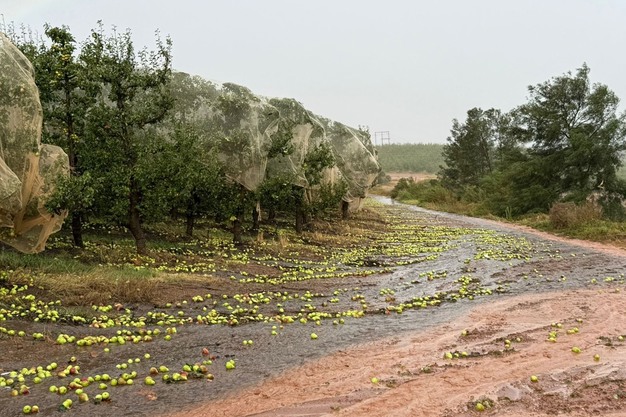 © Riaan StrydomFor two weeks after a microburst during a severe thunderstorm in early February, all they did was pick up fallen fruit
For the two weeks afterwards, harvesting stopped at Bokmakierie Farm; they were simply picking up fruit from the ground. "It's a very time-consuming process, you pick up two, and one of them you've got to drop again, unfit for juicing... It's slow to build up the tonnage. At some stage, you've got to return to the healthy fruit for which you can get a reasonable price. We still have to go back to blocks with 'hail pears' which we haven't been able to strip since the storm of 5 February."
They finished with their Royal Gala apples last week; they'd lost 30% of that as well. The storm notwithstanding, he expects the Langkloof's overall apple tonnages to be higher than last year.
The juice price is a fifth, on average, of what they'd earn through exports, and barely half of the year's production costs.
"The other challenge is that you can't leave fruit lying; you'll get everything you can think of, fruit flies, moths, and you'll feel the effect in the next season. The best is to dig a hole and bury the rotten fruit."
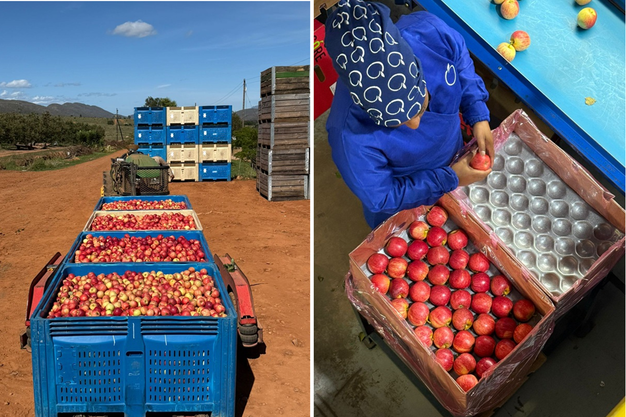 © Riaan Strydom
Bokmakierie's Royal Galas that survived the storm will possibly go to markets in the East or via Saudi Arabia to the emirates
Rainfall 180-degree opposite to usual pattern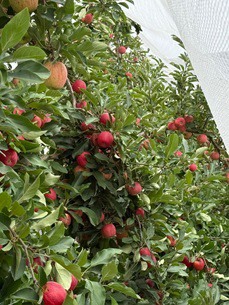 © Riaan StrydomThe whole year had been topsy-turvy: during what is supposed to be the wettest months of the year, they received a scant 100mm, and then during their driest month of February, they received as much as it had rained during the previous six months.
Right: Royal Beaut, protected from the wind and hail by a fixed covered structure
Strydom is the tenth generation to farm on Bokmakierie, near Krakeel in the Langkloof, an area where water scarcity hasn't been as acute as in other parts of the Langkloof, but they were worst-hit during the recent hail event, only one of many. The valley is notorious as one of the most hail-prone places to grow fruit in South Africa.
"You just don't know when it's your turn," he remarks. "In November I was pondering whether I shouldn't perhaps stop putting up more nets" – between 50 and 60% of his farm is covered by drape nets or, better still, fixed nets – "but this has made up my mind. The blocks without nets were ruined."
Moreover, damaged orchards, especially those not under nets, have gone into spring flowering now, early autumn, out of shock, and they already know to expect a lighter crop next year. He is not gloomy. Sometimes, he says, things don't turn out as bad as they'd first seemed.
"We're used to hail. You pick up the pieces, and you go on. But the war – everything depends on how long that goes on, and that, no one knows."
For more information:
Riaan Strydom
Bokmakierie Farm