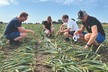
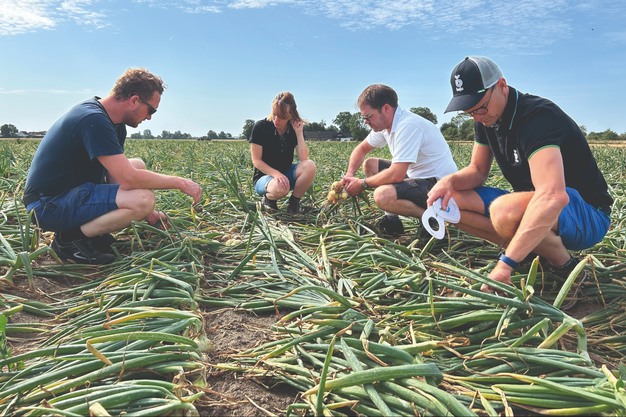
A visit to Denmark and southern Sweden offered a close look at onion cultivation in both Scandinavian countries. Bejo Nordic sales manager Henrik Jørgensen, Denmark sales adviser John Schmidt, Sweden sales adviser Kristina Rosdahl, and Bejo's Geert van Diepen guided the tour across multiple growing plots and processing facilities.
 © De Groot en Slot
The main onion-growing regions in Denmark are Jutland, Funen, and the eastern part of Zealand. According to Henrik Jørgensen, crop establishment was particularly good during the season. "We had a favourable spring with regular rainfall, which resulted in excellent emergence. Most fields were sown in March, and the growing season developed well." Toward the end of the season, however, pressure from downy mildew increased, John Schmidt notes.
In southern Sweden, the group visited several onion fields and a processor together with Kristina Rosdahl, Sales Advisor Sweden. This is the only region in Sweden where onions are grown on a commercial scale. "The growing season also developed well here. The first fields of early direct-sown onions were harvested around mid-August. Yields looked promising, at around 70 tonnes per hectare," says Rosdahl.
 © De Groot en Slot
Figures and facts
Denmark grows approximately 1,574 hectares of onions annually, while Sweden has a slightly smaller area of around 1,350 hectares. These figures include onion sets, which account for roughly 200 hectares in each country. The cultivated area is expected to remain stable in the coming years.
Average yields have remained relatively consistent in recent years, with 65–70 tonnes per hectare for yellow onions and 55–60 tonnes per hectare for red onions. Yellow onions represent about 70 per cent of production, while red onions account for 30 per cent.
A notable feature in Denmark is the high share of organically grown onions, which represent 28 per cent of the total area. In Sweden, organic onions account for around 5 per cent. Organic yields average 35–40 tonnes per hectare.
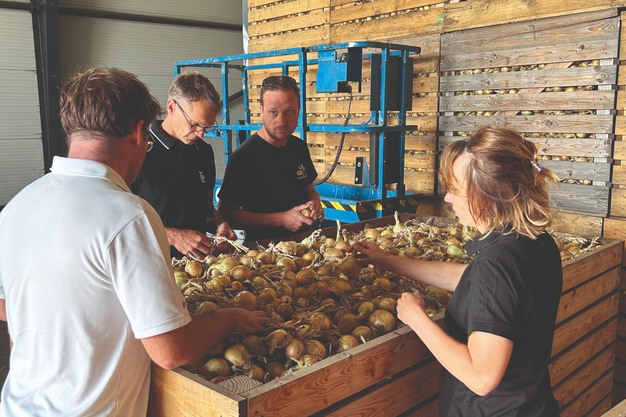
Another striking aspect is the widespread use of B-Mox® primed onion seed in Denmark, where 100 per cent of seed sold is primed. Growers are convinced of the benefits of a faster and more uniform crop establishment. In Sweden, the share of primed seed is around 50 per cent and continues to increase. "Growers here are also increasingly seeing the advantages of B-Mox priming," says Rosdahl.
 © De Groot en Slot
Onions for the domestic market
Most onions produced in Denmark are sold on the domestic market. Around 25–30 per cent is exported, mainly to Sweden, but also to Norway, Germany, Switzerland, Spain, and occasionally the Netherlands. In Sweden, the majority of onions remain within the country, with a small share exported, usually to Norway.
Key varieties in Denmark include Hystore and Hylander. In Sweden, Summit, Hysoon, and Hyway are widely grown. For red onions, Red Tide is the leading variety in both countries.
Opportunities and challenges
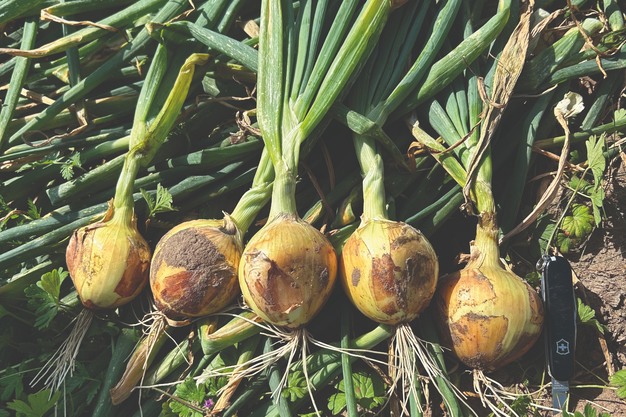
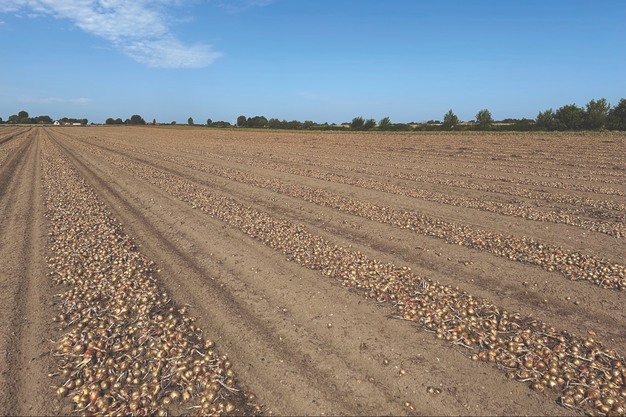
Danish growers face several production challenges, with downy mildew considered the most significant. "Because of our climate, we deal with it every year," say Jørgensen and Schmidt. With fewer crop protection products available, many growers have switched to Hylander, a variety with high resistance to downy mildew.
"The experiences have been very positive," says Schmidt. "With only a few applications, we can keep downy mildew under control. We therefore see this variety rapidly increasing in popularity."
According to Jørgensen, Hylander combines disease resistance with good yield potential and storability. One grower notes that although resistant varieties are more expensive, the investment is worthwhile: "If I lose 15–20 tonnes per hectare in yield each year, that costs far more in the end."
 © De Groot en Slot
In Sweden, white rot is the main challenge. At present, there are limited control options. Growers generally know which fields are infected and avoid planting onions there. Fusarium can also occur occasionally, depending on conditions such as soil structure and heavy rainfall. In some springs, crop losses may occur due to bean fly and onion fly. Due to the relatively mild climate, Danish and Swedish growers do not currently face problems with pink root.
Ample rotation
Despite these challenges, growers see positive prospects for onion production in Denmark and Sweden. "Robust varieties such as Hylander and Redlander perform well under Scandinavian conditions," the advisers note. "With further improvements from breeding programmes, there are good opportunities for the future of onion production in the region."
They also emphasize the importance of maintaining a wide crop rotation and paying close attention to soil health. "That way, we can continue growing onions and contribute to the supply of nutritious food. After all, the onion is one of the most widely consumed vegetables in the world."
Source: Onion Magazine, De Groot en Slot