Victorian grower Mark Trzaskoma believes Australia's apple industry can expand without looking offshore, which presents its own difficulties, if it improves communication with shoppers.
Trzaskoma, Production Manager at Battunga Orchards in Warragul, argues that the domestic market is not fully developed and could be strengthened through better education and engagement.
"I think that if we did increase demand through engaging and educating consumers within our own country, we could go a whole lot better domestically," he says. "Export would be great, and if it all worked, that would be great, you know, we've got work that we could do at home before we need to go overseas."
Trzaskoma says apples are often viewed as workaday fruit despite their diversity in flavour and texture.
"It's not a glamorous fruit," he says. "But it is a staple."
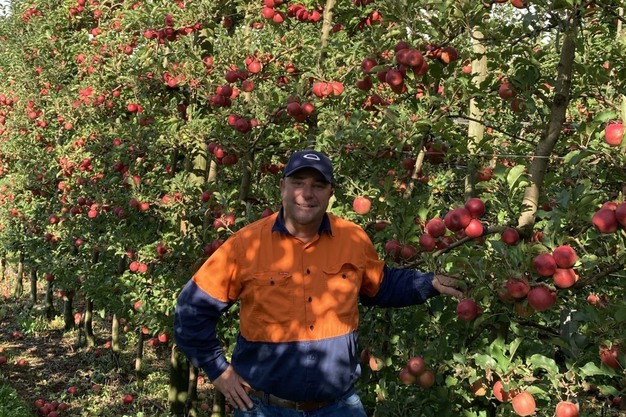 © Buttunga Orchards
He believes more sophisticated purchasers — consumers who understand varietal differences, regional characteristics, and storage requirements — would help lift demand. He points to the wide variation even within a single variety.
"There are numerous different strains of Gala apples and Pink Lady apples," he says. "Even when you look at Jazz and Kanzi, they have the same parentage, but they're different apples."
Regional growing conditions also shape flavour and texture. "You've got hotter climates in some regions, cooler climates with higher rainfall in some regions, and it does all impart its own characteristics into the fruit," Trzaskoma says.
To bridge the knowledge gap, Trzaskoma would like to see a comprehensive QR code system rolled out across fresh produce.
"I'd like to see for fresh produce like a full-on QR code system brought in where someone could scan a code and see who grew it and where it came from," he said. "Learn about how it's grown and learn new things they could do with it, learn how to select it."
He also wants information to flow the other way. "The consumer should be able to provide feedback, which then gets disseminated down through the supply chain," he said. "I think it'd be the best thing that could happen for fresh produce."
While he is not opposed to exports, he acknowledges there is nervousness around long-distance trade.
"It's a long way to send your fruit, and if someone wants to say it's not the quality that it should be when it gets there, and if they pay you back less, people worry about the money," he said. "If the produce isn't great when it gets there, you're going to pay the price for it."
For now, the focus is on the coming season. After four-to-five years of fairly average returns, last season marked a lift.
"This year, the season with last year's fruit, it's been reasonable without breaking any records," he said. "I don't think you'll find anyone who would complain that much in the apple category."
However, weather has created pressure in parts of the operation. Trzaskoma says a big part of his growing area across three locations had been struggling for water over the past two seasons.
"Last year and this year, 40 per cent of our growing operation is struggling for water," he says. "Our catchment in that region only filled to 40 or 50 per cent of capacity this year, so we had to make a call, fairly early to what we are going to do to save some water."
In response, the business has cut back older blocks and renovated trees to reduce demand and improve efficiency. "We're trying to make the best of a bad situation," he says. The heat that has been such bad news for agriculture throughout the southern states has also threatened sun damage to the apples too. They've even been given sunscreen to keep their skin healthy.
That's paid off, with things looking good for a decent crop.
"I think it's going to be fairly stable," Trzaskoma says. "The crop's looking like it's probably going to be similar to last year, and we'd expect the price to remain stable as it has been for the last season."
For more information:
Mark Trzaskoma
Battunga Orchards
Email: [email protected]
Tel: +61 437 363 887