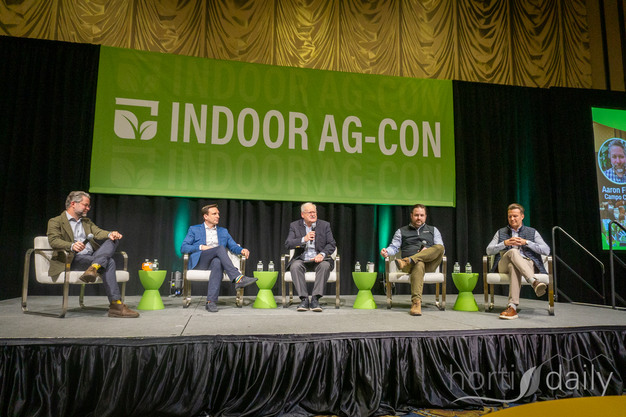
The opening keynote of Indoor Ag-Con 2026, titled "CEA Alliance Insights on the State of the Industry," highlighted a sector transitioning from rapid expansion to a phase of rigorous operational discipline. Moderated by Tom Stenzel, executive director of the CEA Alliance, the session brought together Dane Almassy (Local Bounti), Aaron Fields (Campo Caribe), Jesper Hansen (YesHealth Group), and Josh McClung (Cox Farms). The panel indicated that for high-tech greenhouse and vertical farm operators, the current mandate is to prioritize retail reliability and unit economics over experimental growth.
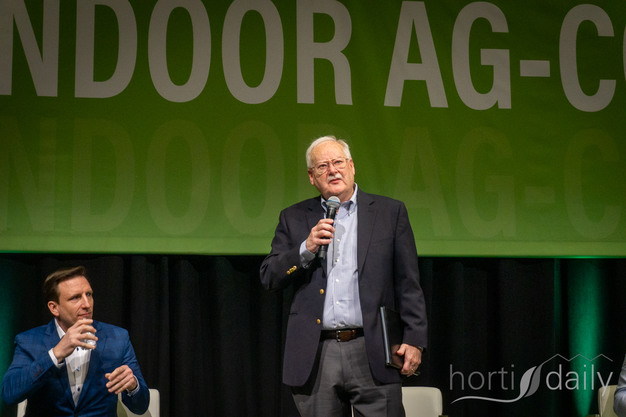 © Arlette Sijmonsma | FreshPlaza.comTom Stenzel, CEA Alliance
The retail mandate: Fulfillment as a non-negotiable
Last Wednesday, on the opening day of Indoor Ag-Con, the speakers emphasized that the primary challenge for the modern grower is not just biological success, but the ability to integrate seamlessly into a professional retail ecosystem. Dane Almassy identified a significant gap between the rising costs of inputs, including labor and utilities, and the pressure to maintain flat pricing on the retail shelf.
"The onus is on us to either drive efficiencies within our business and our supply chain or add additional value-added products to retail," Dane stated. He noted that while retailers were once willing to trial any indoor-grown product, they now expect the same reliability as traditional field-grown supply chains. "The growth within leafy greens or strawberries is going to be predicated by those that have the operational excellence and the capital to support the growth, but ultimately build the trust relationship with the retailer so that you can be counted on to truly replace what is being sourced from the field today."
Josh McClung supported this assessment, noting that retailers are increasingly looking for partners who can deliver "on time and in full" (OTIF). He remarked on the industry's historical struggle with consistency: "We've had such a negative halo in this industry over the past five years, with lots of people coming with lots of cool tech and not focused on the core priority—and that's service me on time, service me in full, and service me with a high-quality product."
The transition from a "tech industry" to a "produce industry" has forced growers to confront harsh operational realities. "We're not a tech industry. We use tech to enable the growing of a lot of our products, but some of the companies came in and did not understand the importance of day-to-day delivering the freshest, highest-quality product consistently," agreed Tom.
Jesper Hansen believes this to be one of the causes of the slow adoption of indoor-grown lettuce in retail, which, instead of taking a few years, took a decade. "Or more, as we haven't really been adopted yet. We carry part of the blame ourselves, because the qualities that we know we can deliver, we didn't really deliver. Sometimes, the retailer just sticks with their safe horses. I think that as we grow as an industry, we become better at running the farms and providing that quality consistently, and retail adoption will be wider and wider."
 © Arlette Sijmonsma | FreshPlaza.com
Operational hurdles: From capital constraints to logistics
Jesper Hansen argued that the industry must move beyond a "binary choice" between greenhouses and vertical farms, focusing instead on what is economically viable for specific climates. He noted that YesHealth has managed to bring CapEx down to approximately USD 700 per growing square meter through a pragmatic approach to technology.
Retail adoption and logistics also emerged as specific hurdles for international growers. Aaron Fields, operating in the microcosm of Puerto Rico, described the difficulty of inserting fresh, locally grown produce into a system built for imported cargo. "The people who go there, it just go to that store. There's no distribution center there at all. And then when I tell them, 'Oh, I have really great lettuce that's fresh, you have to drive to the middle of the mountains,' they lose their minds. They have no idea how to move that lettuce down the island."
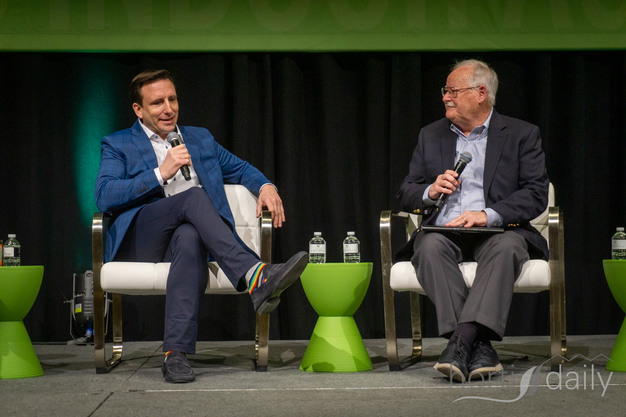 © Arlette Sijmonsma | FreshPlaza.comDane Almassy (Local Bounti) and Tom Stenzel
Education and the value proposition
The panel agreed that a major inhibitor of price growth is the lack of consumer and retail buyer education. Aaron Fields noted that many consumers still do not understand the benefits of greenhouse-grown produce compared to traditional field-grown heads of lettuce that may be weeks old by the time they reach the shelf. "Do you know what a greenhouse is? Do you know why it's better? Get a pulpit, get a mouthpiece, get a microphone—as an industry, I think that is so important right now."
Josh McClung reinforced the need for data-backed education, suggesting that proof of performance is the most effective educational tool for retailers. "As you're educating the retailer on why it's a high-quality product, you have to have a measured performance rate. That's the difference-maker."
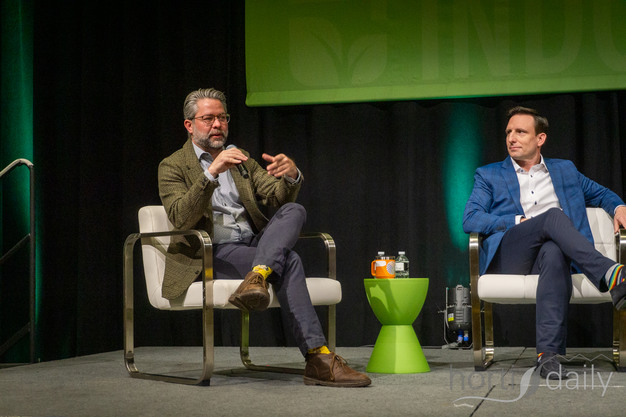 © Arlette Sijmonsma | FreshPlaza.comAaron Fields (Campo Caribe)
The future of crop diversification
While Tom Stenzel shared that the greenhouse sector is currently navigating a period of stabilization, the speakers expressed optimism regarding vine crops and strawberries. Josh McClung noted that greenhouse-grown tomatoes have already proven the viability of the model, and he expects leafy greens and strawberries to follow as the next big crops.
"I don't see any structural difference," Dane said. "I actually think we're more advantaged because within vine crops, you're having unique geographic differences in sources from Canada, the US, and Mexico, with wildly different cost structures, with lettuce having a much more even level playing field." Unlike tomatoes, lettuce is rarely cooked, so cleanliness, food safety, and reduced pesticide use matter even more to shoppers.
The data mentioned by Tom supports the momentum. According to Nielsen, greenhouse lettuce has grown from just 1–2% to about 8% of the packaged salad category nationally in five years, with some regions like the Northeast seeing growth near 20%. "It's the fastest-growing segment of all packaged salads. I'm hopeful we can follow the tomato model."
Jesper Hansen added a technical caveat for other commodities like blueberries, stating that while they are "technically perfectly possible," the economic viability depends on energy costs. "If you take the electricity rate and you halve it or make it one third, I think we can do it."
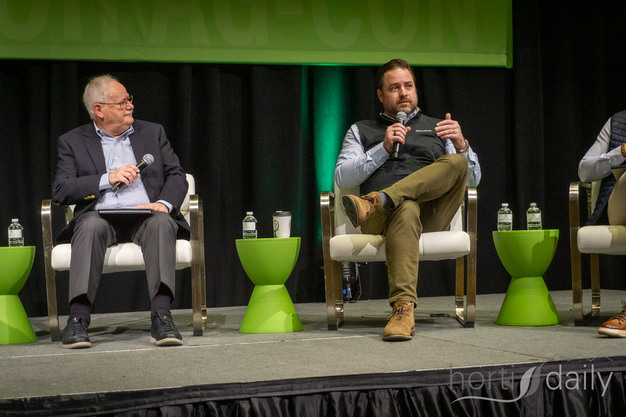 © Arlette Sijmonsma | FreshPlaza.com Josh McClung (Cox Farms)
 © Arlette Sijmonsma | FreshPlaza.com
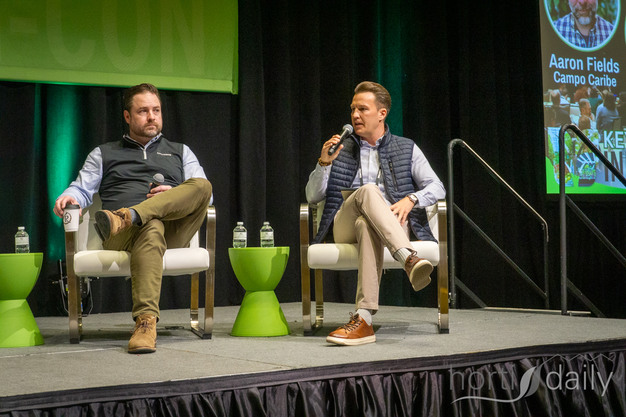
Jesper Hansen (YesHealth Group)
Strategy for suppliers: Sensible over "sexy" technology
The speakers issued a clear call to technology suppliers and vendors in the audience: focus on yield and reliability rather than aesthetic innovation. Jesper Hansen cautioned against "Ferraris" in the greenhouse when "simple is better."
"Lettuce doesn't pay for all those things," Aaron Fields remarked. "Just remember the crop you're working on... leafy greens don't pay for those things. It's just not there."
Dane Almassy concluded by emphasizing the importance of return on invested capital (ROIC) over hype. Regarding the impact of AI, he stated, "It's not a silver bullet today. Our approach is to take a sequence, stage-gated way in which we work through this technology to find very specific use cases that don't introduce a tremendous amount of risk, but that have a very, very clear value proposition."
The session closed with a consensus that the "early innings" of the CEA industry are over, and the winners of the next decade will be those who master the daily execution required of professional produce operators. "Our first customer is the retailer, because he is the one who makes the decision to put us on the shelf. And if we can do that effectively, our belief is the quality of our product will have the natural pull-through velocities to continue to drive that adoption."