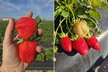
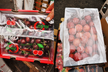
Japanese vertical farming company Oishii has introduced its specialty strawberries to the Canadian market, with the Koyo Berry now available at selected Fortinos stores in Ontario. The retail price is around $30 per pack, with each pack containing eight strawberries.
The product launch followed a social media campaign highlighting pesticide-free production and harvest timing. The strawberries are produced using fully indoor systems rather than greenhouses or open-field cultivation.
According to David Wees, a horticulture and plant science professor at McGill University, this production method is linked to what are known as plant factories. "What they've been doing in the past 10 to 15 years in Japan is trying to grow things in what they call plant factories, which is just a fancy name for completely indoor agriculture," Wees said. "It's not in a greenhouse, it's not in a field. It would be as if you were growing plants inside a warehouse or your basement."
The technical term for these systems is Plant Factories with Artificial Light. Wees explained that strawberries are well-suited to this model because of their market positioning. "It doesn't have to be strawberries. You could do lettuce, tomatoes, and corn if you wanted to. But I think they've been focusing on strawberries because it's a very high-value crop, and people are willing to pay good money for what they see as a perfect, aesthetically perfect strawberry," he said.
Wees said indoor production also addresses long-standing challenges in strawberry logistics. Strawberries are typically harvested before full ripeness to reduce damage during transport. "When they're not fully red, they're not fully sweet. That leaves the berry firmer and therefore can withstand the vagaries of being loaded onto trucks, and sitting on a truck for three or four days before it gets shipped to the store. But the thing with strawberries, if you pick them under-ripe, they basically stop ripening," he said.
By harvesting at full maturity and producing close to end markets, indoor systems aim to reduce variability in fruit quality. The strawberries sold under the Koyo Berry line are uniform in size and appearance.
Wees expects strawberries to be among the first specialty fruits produced through advanced indoor systems in Canada, but not the last. He noted early activity around indoor raspberry production, though transport fragility remains a constraint. "There's been a bit of interest in trying to grow raspberries in what they call protected cultivation, which could be greenhouses or something like a greenhouse. So, raspberries might be another possible fruit to look at," he said.
At present, Wees identified one large greenhouse operation southeast of Montreal and several smaller operations in Montreal that already produce strawberries indoors year-round on a limited scale.
Source: Now Toronto