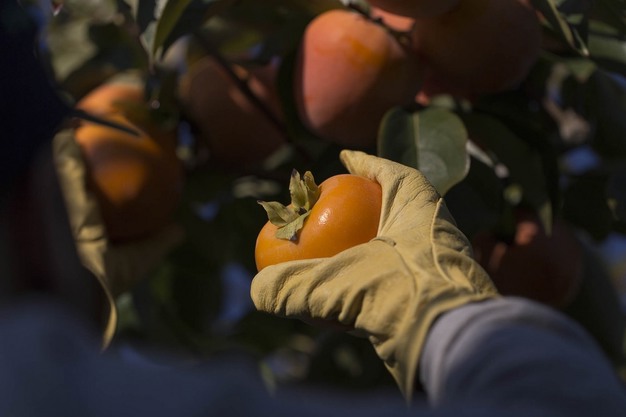
The Rojo Brillante kaki season is about to come to an end for the second-grade cooperative Anecoop, the largest producer and operator working with this fruit in Spain, with around 50% of the country's total volume. This is the end of a generally positive season, with a lower production than initially forecast due to the smaller sizes harvested and with acceptable prices, although below expectations, given the available supply.
 © Anecoop
"Week 4 marks the end of our kaki season," says Ángel Cebriá, Product Manager for this product category at Anecoop. "It might still be possible to buy kakis for a couple more weeks, but afterwards it will be really difficult to find any with the characteristics of the ones we sell, with their turgid texture and lack of astringency."
"We are closing the season with around 120,000 tons, compared to the 165,000 initially forecast, mainly because we've had a higher percentage of small and medium sizes due to the impact of the heat waves in August," says Cebriá.
The Kaki Product Manager at Anecoop says that there has been a lower incidence of pests compared to previous years. "Pests and diseases such as cotonet have been under greater control this year thanks, among other things, to the effective release of useful fauna."

Ángel Cebriá.
According to Ángel Cebriá, prices have generally been acceptable this season, although they have not really been in line with the available supply. "There has been a lack of kakis to meet customer demand during practically the entire season. In spite of the improvement in prices, this imbalance between supply and demand has made it difficult to meet our expectations, taking into account the higher production costs in recent years and the lower commercial returns. It's worth recalling that an average of around 18% is lost in each batch.
This rise in costs, together with the lack of generational replacement and the crop's difficult management, has actually led to a reduction in Spain's acreage, although Anecoop is maintaining its supply and continues to renew around 100,000 plants a year with the aim of improving yields.
"Less specialized kaki growers outside organizations with an infrastructure such as ours are subject to a lot of uncertainty," says Cebriá. "At Anecoop, we continue working to extend the kaki marketing period by improving cultivation techniques, renewing plantations, and trying to achieve progress in researching and obtaining new varieties," he says.
For more information: www.anecoop.com