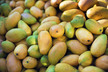
Fruit markets in Bengaluru are reporting the early arrival of mangoes during winter, several months ahead of the usual summer season. Traders say off-season volumes have been arriving steadily since late December, earlier than the typical March start to the mango campaign.
According to wholesale and retail vendors, varieties currently available include Neelam and Banganapalli. These mangoes are mainly sourced from orchards in parts of Tamil Nadu and Andhra Pradesh, where off-season cultivation practices are increasingly used.
Current prices reflect limited availability. Neelam mangoes are selling at around Rs 160 per kilogram (US$1.93 per kg), while Banganapalli mangoes are priced at approximately Rs 150 per kilogram (US$1.81 per kg). Traders note that these levels are higher than typical summer prices, when larger volumes enter the market.
Despite the early presence, traders report that sales remain slow. Consumers are showing interest by inspecting the fruit and asking questions, but many are not buying. Vendors attribute this to concerns over artificial ripening and pricing. Several buyers associate off-season mangoes with chemical treatment or weaker eating quality and prefer to wait for the summer crop.
Agricultural specialists say the early supply is linked to changes in orchard management. In several mango-growing regions in southern India, farmers use controlled cultivation methods to induce flowering outside the normal cycle. This involves applying plant growth regulators to the soil at specific stages of crop development, allowing harvests between October and December instead of the traditional summer window.
Experts state that the use of such growth regulators is permitted when applied according to guidelines and that they do not leave residues in the fruit or soil when used correctly. They also point out that confusion remains between flowering induction methods and artificial ripening, which uses banned chemicals and is not allowed.
Traders indicate that clearer information is needed to address consumer concerns, particularly in urban markets such as Bengaluru. At present, off-season mangoes are viewed more as a curiosity than a regular purchase. Most sellers are limiting volumes to manage risk, given the slower turnover.
New arrivals are expected to remain limited in the coming weeks. Market participants suggest that unless prices ease or consumer confidence improves, demand will stay modest, with peak mango consumption continuing to be concentrated in the summer months.
Source: News 18