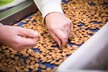
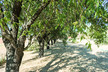
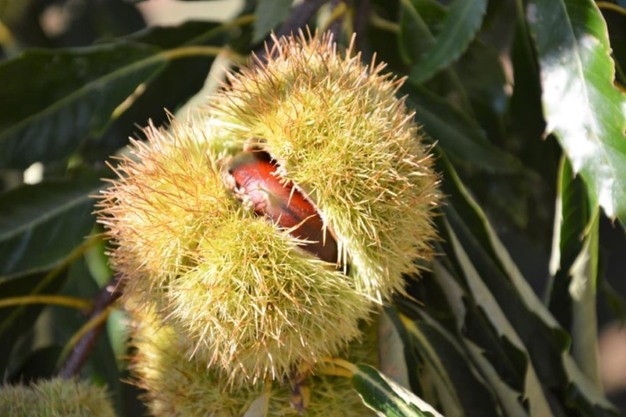
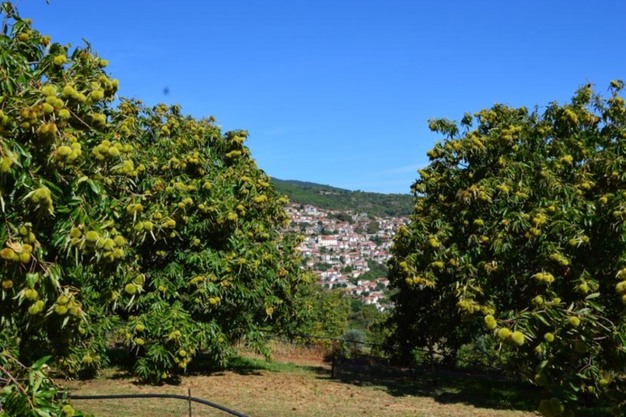
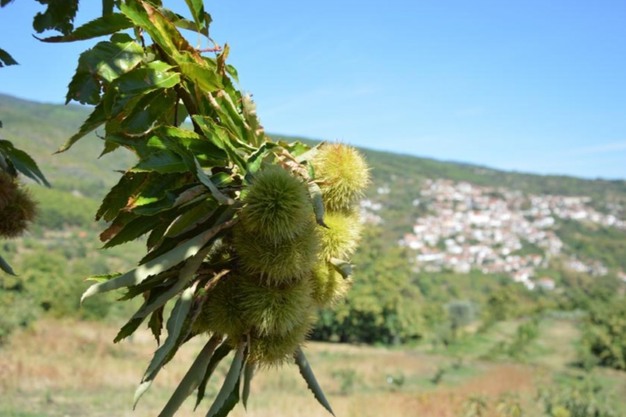
In Melivia, Larissa, a key chestnut-growing area in Greece, this year's production was lower than the average of recent years, but distinctly higher than last year's. "Regarding the size of the fruits, we observe the usual pattern. That is, 60% to 70% of the production falls into the first two size categories," comments the president of the local cooperative, Mr. Vaggelis Kraniotis.
 © A.C. Melivia
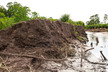
Chestnut cultivation in Melivia, as in the rest of Greece, suffers from chestnut blight and the chestnut wasp. Mr. Kraniotis explains: "Blight causes a loss of vegetative capital, not only in Melivia but in all chestnut-growing areas of Greece. Unfortunately, we cannot quantify the extent of the damage. On the other hand, other production issues, such as the chestnut wasp, show different patterns depending on the age of the infestation. Trees affected earlier are starting to recover in terms of productivity, while in more recent infestations, the impact on production is more severe. Although it is a problem that will continue, progress is being made with the application of appropriate control methods against this parasite."
 © A.C. Melivia
Regarding market developments, Mr. Kraniotis notes that "The situation is satisfactory, and in view of the Christmas holidays, demand is expected to increase, both from our country—even though imported chestnuts are also available—and from the Balkans. Exports were made to Italy at the beginning of the season, but these have now been completed. Overall, the market has a steady flow."
Most importantly, he adds, there will be product available for Christmas this year: "Last year, there were no chestnuts for Christmas. This year, it will be different. There is a product for the Christmas market—not abundant, but it exists. I believe the stocks will be depleted by January."
 © A.C. Melivia
Finally, chestnut producers in Melivia are also participating in the protests that Greek farmers are carrying out across the country these days. "We are residents of mountainous, disadvantaged areas, trying to support our families and our activity under the burden of extremely increased production costs and without receiving the compensation we should for the losses of our vegetative capital," concludes the president of A.C. Melivia.
For more information:
Vaggelis Kraniotis
A.C. Melivia
Tel: +30 2410 619 313
Email: [email protected]
https://acmelivias.gr/