Sea-Intelligence has released issue 170 of its Global Liner Performance (GLP) report, providing schedule reliability data through September 2025. The 120-page report tracks performance across 34 trade lanes and more than 60 carriers.
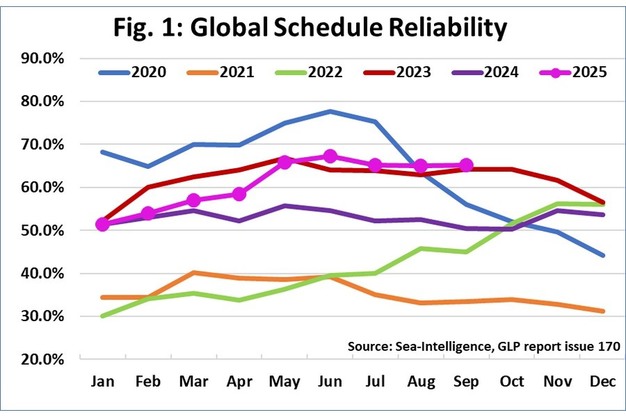
According to the latest data, global schedule reliability recorded a month-on-month increase of 0.1 percentage points to 65.2%, marking the second-highest level for September between 2019 and 2025. Year on year, reliability improved by 14.7 percentage points. The average delay for late vessel arrivals remained unchanged from the previous month at 4.88 days.
 © Sea-Intelligence
Among the top 13 carriers, Maersk achieved the highest schedule reliability at 77.0%, followed by Hapag-Lloyd at 73.6%. Five carriers each were in the 60–70% and 50–60% reliability ranges. Wan Hai reported the lowest performance at 47.9%.
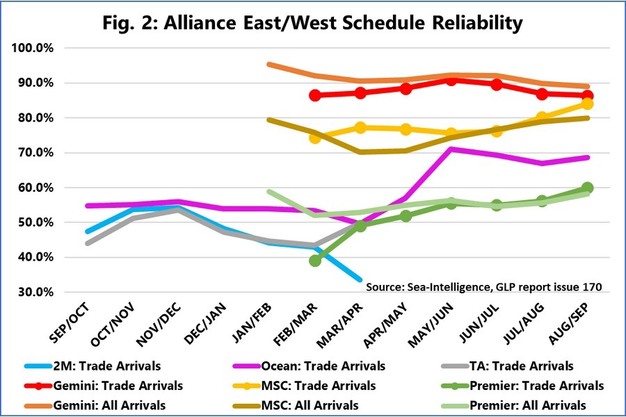
Sea-Intelligence continues to track alliance performance using two measures: "All arrivals," which includes both origin and destination port calls, and "Trade arrivals," which focuses on destination ports. The new dual-measure approach was introduced earlier in 2025 to reflect the transition to updated alliance structures.
 © Sea-Intelligence
In August and September 2025, Gemini Cooperation recorded a schedule reliability of 89.1% for all arrivals and 86.4% for trade arrivals. MSC followed with 79.9% for all arrivals and 84.1% for trade arrivals. Premier Alliance recorded 58.2% for all arrivals and 59.9% for trade arrivals. Among the older alliances, Ocean Alliance recorded 68.6% reliability, with identical figures for both metrics.
Sea-Intelligence noted that once the new alliance structures are fully operational, the "All arrivals" and "Trade arrivals" measures are expected to converge.
For more information:
Alan Murphy
Sea-Intelligence
Email: [email protected] / am@sea‑intelligence.com
www.sea-intelligence.com