The 2025 stone fruit harvest in Spain, which started with a delay of between ten and fifteen days in the earliest areas and has been maintained throughout the season in all producing areas, has been reduced by the impact of hailstorms and has been under less pressure from third countries, so prices have reached higher levels. Will the balance be positive enough to motivate the sector to continue investing and stop the downward trend in the acreage?
"In the 2025 season, from April until the third week of July, there was generally higher demand than supply due to the incidence of hailstorms, especially in Murcia, Catalonia, and Aragon, as well as good consumption thanks to the warm weather in most of Europe. August has been characterized by apathetic demand and a quieter market than usual," says Santiago Vázquez, Sales Director of La Vega de Cieza.
 © Joel Pitarch | FreshPlaza.com
The company from Murcia produces and sells around 23 million kilos of stone fruit every year, as well as between 4 and 5 million kilos of persimmon. With around 60 associated growers, they cover the full range of stone fruit, 90% of which comes mainly from Murcia, where plantations are spread across different areas at different altitudes, ranging from 0 to 500 meters above sea level.
"This year, production in Murcia was reduced in mid and late season areas due to the severe impact of hail, which resulted in a general lack of fruit that was quite remarkable between June and mid-July, coinciding with the late start in Catalonia and Aragon." From April 7 to June 30, hailstorms have been recorded every week, with varying degrees of intensity, in different parts of the country. These storms have particularly affected fruit crops, causing damage to more than 31,000 hectares.
In Catalonia, one of the main growing areas, stone fruit volumes in 2025 have stood around 30% below their productive potential, and only a limited share of the harvest has been suitable for fresh sales due to the impact of hail. Santiago Vázquez says that "the deductibles and limits on insurable quantities mean that agricultural insurance only covers part of it for those losing everything due to adverse weather conditions."
Higher prices in 2025, higher profitability?
The losses due to the impact of adverse weather, as well as the lower supply of fruit from other Mediterranean countries such as Turkey, Greece, Moldova, and Hungary, among others, have caused prices to rise compared to the previous season, with averages more than 25% higher for nectarines between late June and early July compared to 2024.
"Although prices have been higher in the 2025 season, we cannot forget that yields have also generally been lower and that production costs continue to rise, both for production inputs and labor, given the shortage of local workers," says Santiago Vázquez.
"Therefore, despite the fact that prices have been higher, the profit margins of companies that haven't been severely affected by hail could still, in many cases, be similar to those of previous seasons. In most cases, I wouldn't think they'll have managed to make more money."
 © La Vega de Cieza
The Sales Director of La Vega de Cieza says that we must also not lose sight of the growing presence of third countries in European markets, as although this year has suffered significant losses due to the impact of the frosts, they continue to grow in terms of production.
"Countries such as Turkey or Moldova, among others, continue to expand their stone fruit plantations and are increasingly opting for the same varieties that we plant in Europe. These countries are close to Russia, and that's naturally their most important market, but they also have their eye set on Europe, as there are also European growers, including Spaniards, investing in these countries to be able to produce more cheaply. The fact is that salaries, social requirements, and regulations on the use of active materials cannot be compared with European standards and regulations, so competition with these countries is really unequal and will undoubtedly make us less competitive unless mirror clauses, among other measures, are enforced."
Unstable apricot yields. Platerina growing in the shadow of the success of Paraguayo peaches
In recent years, apricots have been showing significant variations in yields and a downward trend. This year, production has fallen significantly compared to the previous season, when it reached the highest level since 2018.
"In general, we are seeing lower yields in apricot plantations located in different producing areas, both in Spain and in other countries. Although I believe that part of this is due to the impact of climate change and the reduction in the amount of chilling hours, I also think that the varieties themselves are no longer as productive. Varieties that ten years ago gave abundant harvests have seen their yields drop in all parts of Spain, regardless of the number of hours of cold. The same is happening with the platerinas, although within a much shorter timeframe.
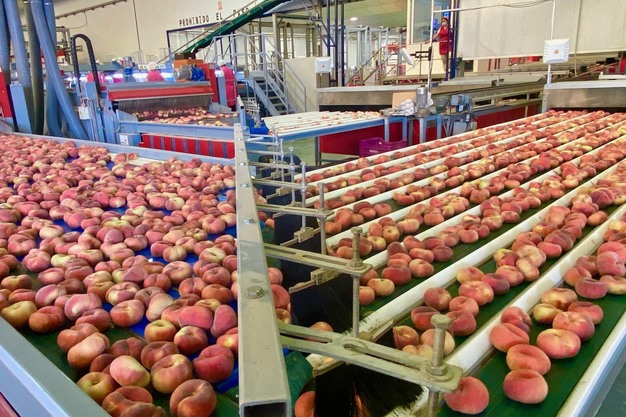
The platerina, or flat nectarine, is a species that is gradually gaining ground in terms of production and consumption. "We already have around 2,000 tons. It is a tasty variety and easy to eat because of its shape and the fact that it has no stone; however, it is not quite as juicy or as homogenous and stable as the Paraguayo peach, which practically never disappoints consumers when they buy it. Since its introduction, Paraguayo peach consumption has doubled every year. The platerina is a great product, but for the time being, I don't expect it to become as popular as Paraguayo peaches," says Santiago Vázquez.
The area devoted to stone fruit cultivation in 2024 fell again and stood at 125,580 hectares, which is 15% less than in 2017, according to figures from the Spanish Ministry of Agriculture, Fisheries and Food (MAPA). Peaches are the crop with the biggest drop in the acreage these years, with a 23% reduction, while in 2024, compared to 2023, nectarines have experienced the greatest decline (-7.7%). By regions, all the main producers reduced their acreage in 2024 compared to 2023, except Aragon (+1.3%) and Castile-La Mancha (+0.3%). Catalonia's fell by 2.7%, Murcia's by 3% and Extremadura's by 1.6%.