Last Thursday (28 August), at the launch of the annual apple-pear campaign in Paris, Xavier Le Clanche, technical manager of ANPP, took stock of the plant protection solutions available and outlined the outlook for the orchards. To date, there are insufficient resources to provide effective protection against the main pests and diseases. This situation has led the group to turn to research and experimentation for short-term solutions.
"Every year, production is threatened"
Production conditions, which are already difficult, are going to get worse," warns the technical manager. "Today, production requires a large number of waivers for both organic and conventional farming. These occasional authorizations allow us to maintain a minimum level of protection, but that is not enough." Concerns are particularly acute with regard to ash aphids. The announced ban on lambda-cyhalothrin (Karate K) in 2026 will drastically reduce the margins for manoeuvre. "By 2026, we will have very limited options to combat the ash aphid: "Two effective solutions (deltamethrin and tau fluvalinate), compared with 8 for our European competitors." The same concerns apply to changes in the conditions of use of Coragen, used to combat codling moths. "It is a sword of Damocles hanging over production every year."
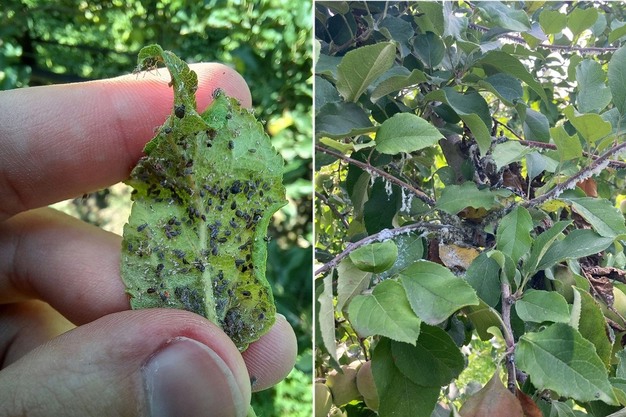 © ANPP Ash aphid
"Captane will be authorized, but we do not know if it can be used"
The situation is just as uncertain for Captane, the key molecule in the fight against scab, whose European approval* was renewed last year, albeit subject to conditions. The problem is that "the conditions of use imposed have not yet been defined." [The strict conditions for outdoor use include the fact that it may only be used outside the flowering period, and only if there are no weeds in bloom between the rows and using precision spraying equipment (bonnets, screens, sensors...) capable of reducing exposure per hectare by at least 61%, and loss to the ground by at least 20%, compared with conventional equipment]. "We are still in a regulatory limbo, especially with regard to the equipment referred to in the European regulation. It is not clear whether it corresponds to existing equipment in our orchards or even in our suppliers' boxes. Captane may be authorized, but we do not know if we will be able to use it."
* European regulation as of September 3rd, 2024 / source: eur-lex.europa.eu
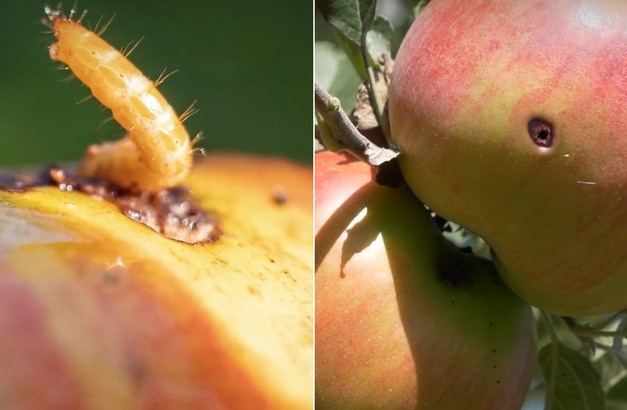 © Vergers écoresponsables Codling moth
Hope for a new text on Acetamiprid
The third black spot remains Acetamiprid, used in particular to combat the ash aphid. This neonicotinoid insecticide, authorized in the European Union until 2033, is widely used by competing producers (Italy, Spain, Belgium, and Poland). And the difference is significant. Of the 9 million tons of apples and 1.65 million tons of pears produced in Europe using this molecule, almost 200,000 tons reach the French market each year. The draft law put forward by Senator Laurent Duplomb, aimed at reintroducing its use in France subject to conditions, raised a lot of hopes, but its censure by the Constitutional Council last August caused a lot of ink to flow. "It was a real slap in the face, but there is still hope," explains Gilles Baraize, director of FNPFruits. A few days after the censure, the senator declared that he would not rule out submitting a new text, this time taking into account new criteria. "If the rewrite is done intelligently, there is a chance that it could be successful. We will have to show more teeth on this issue, which will also involve legal action."