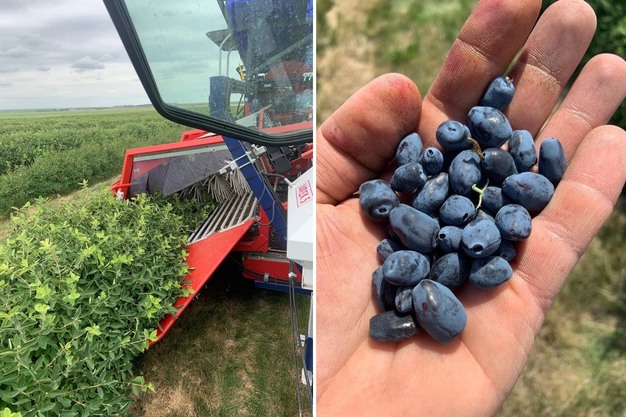
Last week, the annual harvest of Haskap berries finished at Phoenix Haskaps' 30-acre farm in Alberta, Canada. The company has been growing the unique and elongated berry since 2016 and is one of about ten Haskap growers in Alberta. In total, the province is home to 200 acres of Haskap berries. "We started growing this particular berry variety because of its health benefits," says Joel Mans with Phoenix Haskaps. "They have the most antioxidants of any berry on earth and contain three to five times as many antioxidants as blueberries." In addition, they contain three times more polyphenols than blueberries do. Polyphenols reduce bad cholesterol, increase good cholesterol, and decrease inflammation.
 © Phoenix Farms
Processing industry
Harvest typically takes place in early July and immediately after harvest the berries are flash-frozen. The large majority makes it into the processing industry and only a fraction of production volume is consumed fresh. "Haskap berries have a very thin skin and a short shelf-life and are therefore less suitable for the fresh market," commented Mans. In processed format they are sold as frozen berries and used as an ingredient in yogurt or smoothies. In addition, they are pureed, used in jams and also used as toppings to complement a range of dishes. Phoenix Haskaps also uses the berries as an ingredient in the wines from their winery.
 © Phoenix FarmsHaskap wine from Phoenix Haskaps' own winery.
Domestic versus export
The Haskap variety grown by Phoenix Haskaps is a cross between a Japanese Haskap and a Russian Haskap. The Japanese Haskap grows low to the ground and has a very sweet taste while the Russian Haskap grows upright and has a bitter taste. "Since the berry is well known in Japan, I expected Japan to be a big market for us," commented Mans. However, it turned out that the large majority of the berries are sold in the domestic market. "We sell some to South Korea and the U.S. but the majority stays in Canada." Mans also expected to sell significant volumes to the wholesale market, but the berry variety is not well known enough. "It turns out that most growers use the Haskap berries as ingredients in different food products they bring to market and some volume is purchased by small wholesalers.
Alberta's growers are marketing their Haskap berries through a cooperative called Vitalaberry. The majority of Alberta's Haskap berries are processed at Prairie Hill Farms, located very close to Phoenix Haskap's farm. From there, the fruit is marketed by Vitalaberry.
 For more information:
Joel Mans
Phoenix Haskaps
Tel: (+1) 403-308-3502
[email protected]
www.phoenixfarms.ca
www.vitalaberry.com