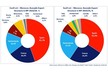
China's importation of fresh durians has faced setbacks this year due to enhanced sanitation checks at the border. The General Administration of Customs reported a 32.5% dip in the value of fresh durian imports to U.S.$1.93 billion in the year's first five months. Import volume also decreased by 32.9% to 390,900 tons.
Vietnam experienced a nearly 62% year-on-year reduction in both value and volume, with shipments totaling U.S.$254 million during the first five months of 2025. Imports from Thailand showed a 24% decline in U.S. dollar terms, totaling U.S.$1.67 billion, although the volume decrease was less severe. Thailand remains China's primary durian supplier, followed by Vietnam and other Southeast Asian nations.
Trade observers attribute the slowdown to tightened regulations concerning pesticide residue and sanitation standards. Nguyen Thanh Trung, a political scientist at Fulbright University Vietnam, stated, "Vietnamese growers and traders need to meet the standards." This adjustment period may impact Vietnamese growers temporarily.
Sam Sin, development director at Hong Kong-based exporter S&F Produce Group, noted modifications to China's customs policy, specifically in assessing pesticide residue against set limits. Durian, often called the king of fruits, is in demand throughout China, fetching prices of up to 200 yuan (U.S.$27.87) for a 6kg fruit. Its popularity spans middle-class families, dessert creators, and gift-givers for events such as weddings.
Despite the growth potential, Chinese supermarkets maintain stringent food safety norms. Earlier in the year, durian shipments underwent inspections for toxic dyes and heavy metals, per VietnamNet, associated with Vietnam's Ministry of Information and Communications.
The Communist Party of Vietnam's media outlet, Nhan Dan, highlighted that more than 92% of Vietnam's durian exports were directed to China last January, but by this January, that share had reduced to 57.6% due to "stricter controls." Lim Chin Khee, adviser to Malaysia's Durian Academy, referenced China's "tightened customs inspections and quality control."
Local Vietnamese growers face challenges due to a lack of fruit testing labs, as noted by Huynh Xuan Son, a durian grower in Binh Thuan province. This shortage has delayed export approvals and affected competition with Thailand, which established rapid testing facilities, according to Dan Martin of Dezan Shira & Associates.
Source: myNEWS