



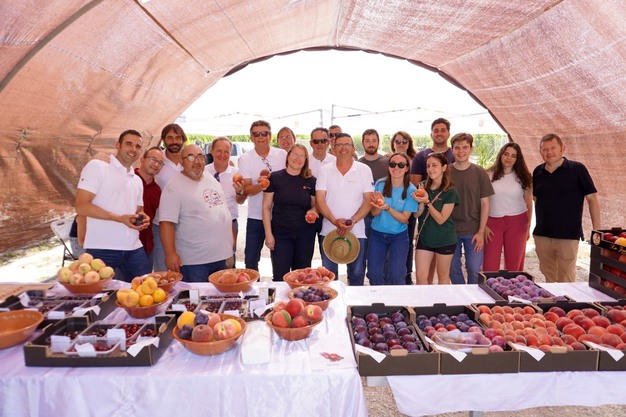
New peach and platerina varieties resulting from the research of the FrutIMIDA peach genetic improvement program, and which will serve to extend the harvesting season, were presented a few days ago in the Spanish municipality of Abarán, in the province of Murcia.
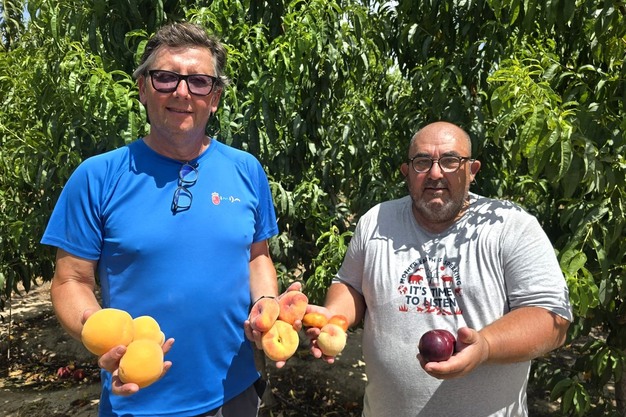
The two new yellow peach varieties are part of the Levante series. "Their harvesting time will fall between those of the Levante 5 and the Levante 45; in other words, one will be harvested in the third week of May and the other in the first week of June. We have also introduced a new variety of platerina which will be harvested in the second week of June," says FruitIMIDA researcher José Cos.
 © FrutIMIDA
The Pavia peach is a very old variety from Cieza and a favorite with consumers in Spain, Greece, and southern Italy. It is fully yellow, firm, and with good organoleptic characteristics. "We are trying to introduce new varieties in the schedule with the idea of keeping it available from early May until the end of the season, which in some areas, such as Jumilla, lasts until October," says the researcher.
Chatum, the flat yellow peach
In addition to this, Cos says that they are also "researching flat shapes in the field of Pavia peaches with the idea of transferring the organoleptic characteristics of flat peaches to yellow peaches. We have obtained a flat-shaped peach and we have called it Chatum."
As for the reason to want a flat-shaped peach, the researcher says that "in the consumer's mind, a relationship has been established between this shape and the fruit's sweetness. That is why we are striving to obtain a Pavia with this shape, which will stand out for its sweetness and sub-acidity. High or low acidity is accepted with nectarines, but consumers expect flat-shaped fruit, like a flat peach, to be sweet," he says.
Regarding the success of platerinas, the researcher says that it is due to "their ease of consumption and remarkable flavor, which makes them very attractive for children." As far as cultivation is concerned, "it is not so easy, because they inherited the cracking problems of flat peaches and the skin of the nectarine. The platerina's skin is also sensitive to our very high solar radiation and can show marks. This is an issue that needs to be researched further."
The researcher stresses that "it is very important for the fruit to have the right flavor, but also its round shape, color, and firmness, because it has to last several days in the supermarket."
 © FrutIMIDA
"We believe that consumers can be won back with the right flavor and quality. We want to leave behind the years in which fruit lost its sweetness and only delivered a good appearance and productivity. Nowadays, there are all kinds of fruit all year round, so it is necessary to make an effort to supply products that are not only attractive because of how they look," says Cos.
The vision of the grower and that of the other members of the chain play a key role. "We have to meet the needs of producers, supermarkets, exporters, shippers, and, of course, the end consumer. It is a radial relationship; everyone's demands must be satisfied."
Winter rest that is not coming
Winter rest is another of the key points for stone fruit. It's a fact that winters are becoming hotter, and the trees haven't had time to adapt, and their productivity has been reduced to such an extent that many growers have decided to uproot them.
"We invest many resources in the study of cold in growing chambers to gain in-depth knowledge of the adaptation of varieties to certain areas and to estimate their cold and heat requirements. With climate change, some varieties won't possibly remain productive," says the researcher.
Other lines of development for FrutIMIDA are the yellow-fleshed red peach in the Alisio and the white-fleshed red peach in the Poniente. As for flat peaches, "four varieties are standing out the most within the Siroco range, unique in terms of color, pistil closure and organoleptic qualities," says Cos.
FruitIMIDA's stone fruit developments are reaching Spain, Europe, and even Chile, South Africa, and Australia. Research is also conducted on plums and dragon fruit.
For more information:
José Cos
FrutIMIDA
Tel.: +34 968 366 716
[email protected]
https://www.imida.es/frutimida


