An Australian fresh produce trading company says the sizing and quality of this year's feijoa crop is the biggest it has seen grown in the country.
A subdivision of Produce Art, Feijoa Addiction is a major supplier and marketer of the fruit. Director Rohan Bicknell explains that it was a wet summer growing season across Australia.
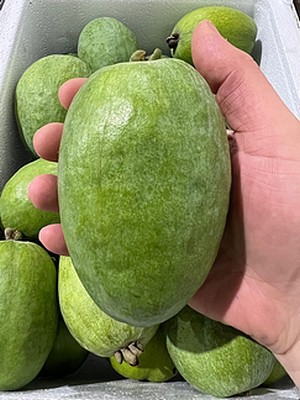
"One of the negatives is that the pollination hasn't been as great, so there is probably less fruit on the trees," he said. "But the positive is that the fruit that is on the trees is extremely large, so we are getting some phenomenal sized fruit. One piece of fruit was as big as 368 grams for example, which is very unusual. Traditionally, you would say 60-100g would be normal, but we are seeing it more above 100 grams. But every year we do feijoas, sizes seem to be on the general increase as our growers work on their orchard practices, which is good because they bring the best dollar back to the grower."
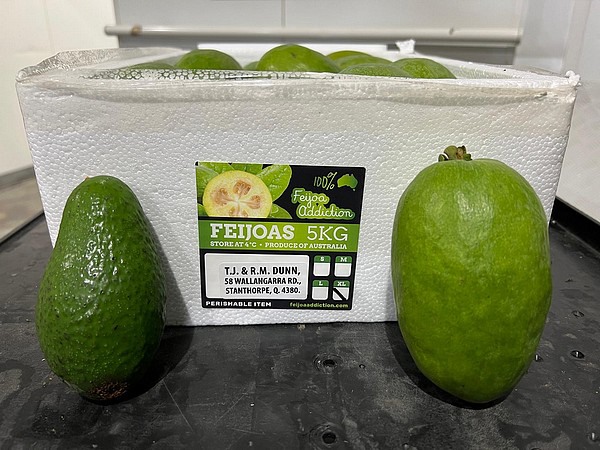
The main growing areas for the fruit in Australia are the Granite Belt (near the Queensland and New South Wales state border), The Bega Valley in NSW, several locations in Victoria, The Riverland and the Adelaide Hills in South Australia as well as the Southern Forests region of Western Australia. As a whole, the Australian feijoa industry is now producing over 100 tonnes in terms of volumes, and this year Mr Bicknell says it is the first time they have not had to import fruit from New Zealand, where production is much higher across the Tasman.
"Traditionally, we would import a lot from that part of the world, but volumes are getting much larger and the need for NZ feijoas in Australia is becoming less and less," he explained. "They still grow an amazing product, I must say. New Zealanders are usually the first port of call when it comes to feijoas; it is one of their main national fruits – fortunately, there are a lot of kiwi ex-pats in Australia who help drive growth. Originally the fruit was in small quantities with little to no promotion being done with them. As years go on, it is great to see that so many other nations have the connection with feijoas; from its native land of South America to parts of Europe including Russia, the Caucuses, Israel, China, and Japan - we get contacted by fellow Feijoa lovers. You also find a lot of Asian cultures that have become fond of the feijoa when themselves or their family have lived in NZ. Australians are even finding out about the fruit and are starting to enjoy it. We are starting to build knowledge and growing techniques, so it is becoming a real industry here."
Feijoa exports from Australia have been on the rise, although COVID-19 disruptions have slowed supply slightly, and Mr Bicknell is looking forward to it rising again soon. He added that the key to selling the fruit is to focus on the flavour rather than the shelf life, especially given Asia is one of the main destinations and they normally prefer sweeter products.
"From the outside, it looks sort of like a lightly coloured avocado or a guava," Mr Bicknell said. "But the characteristics that come to mind are first of all the smell - it has an amazing perfume. When you cut the fruit open you will also find this jelly centre that is super special and delicious!. Another positive is there are no seeds that get in the way, a lot of people use it like kiwifruit and the skin is completely edible."
For more information:
Rohan Bicknell
Produce Art
Phone: +61 409 907 626
[email protected]
www.produceart.com.au