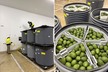
Ethylene is a plant hormone that regulates a wide range of biological processes. It is associated with the ripening processes in a number of fruits such as apples and pears. Better understanding of the effects of ethylene concentration on the ripening process can lead to improved management of fruit harvesting, storage and transportation.
A research team led by Prof HUANG Dejian from the Food Science and Technology Programme at the Department of Chemistry, NUS has developed fluorescent probes which provide a convenient way to visually detect the presence of ethylene gas released from the fruit ripening process through a simple fluorescence microscope.
The probes are developed from a class of transition metal carbene complexes known as Grubbs catalysts and can detect ethylene up to a level of 0.9 parts per million in air. In the presence of other possible gaseous species which may also be emitted by ripening fruits, the research team found that the effectiveness of the probe in detecting ethylene gas is not affected, showing that the probe is selective. This probe could be used to determine the ethylene formation during fruit ripening to determine the fruit maturity levels for harvesting and storage.
As explained by science.nus.edu.sg, the probe contains weakly fluorescent molecules which are activated when exposed to ethylene gas. The colour intensity increases when more ethylene gas is detected. The research team used the probe to monitor the ethylene gas emitted by four different types of fruits (passion fruit, avocado, banana and apple) and found that the ethylene release rate increases linearly with storage time.