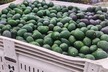
A peculiar citrus cultivation of Australian origin, typical of the subtropical humid rainforests of southeastern Queensland and northern New South Wales, has also recently been growing in the Mediterranean, in Italy, namely the finger lime (Citrus australasica).
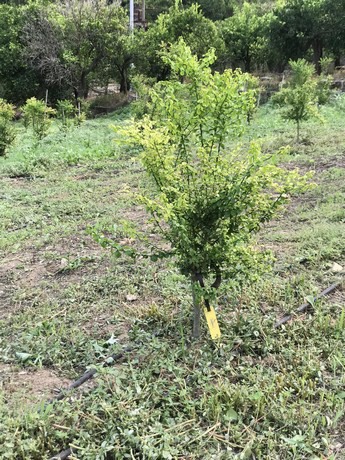
This thorny plant is not more than five meters tall and is characterized by a few leaves and the typical growth pattern of an undergrowth species. It does not require large hectares of cultivation, but it needs care and protection from the wind, to such an extent that the producers are investing in greenhouses to protect the shrub.
Given its price (the cost of the fruit is of 150 euros per kilo and 50 euros for a single plant), it is used and appreciated only in specific sectors, such as star-rated restaurants. The most requested and used varieties are Emerald, Byron Sunrise, Pink Ice and Yellow Gold.
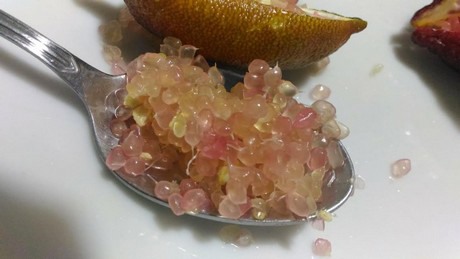
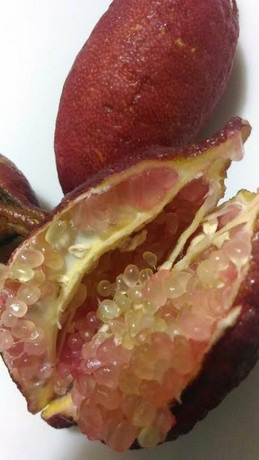
FreshPlaza met some Sicilian producers specialized in the cultivation of this fruit, also known as "lemon caviar" because its spherical and juicy vesicles recall the sturgeon's eggs. This year, the production was positive: the "Consorzio Finger Lime" ("Finger Lime Consortium", translator's note) obtained about five hundred grams of fruit per plant (including the two-year-old plants).
As pointed out by Marco Battaglia, vice president of the Consortium (established in 2016 by himself and president Marcello Cividini, a professor of the Polytechnic University of Milan, "Politecnico di Milano"): "It makes more sense that finger limes would be used as a spice instead, because as a fruit it has little yield. However, considering its strong taste (due to the content of sabinene) and its unique skin, suitable for multiple extracts, the high price on the market is justified".
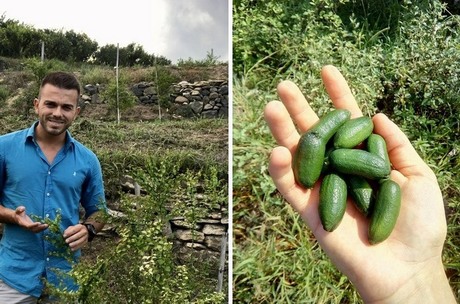
There are however specific criteria which one should not ignore if one wishes to operate professionally in this segment. Marco Battaglia explains that the Consortium is based on three main areas: development, protection and rationalization.
The moment of development begins with the nursery production of certified and guaranteed plants both under the varietal and phytosanitary aspects. In addition, it coordinates marketing and public relations with buyers, public and private bodies and authorities.
As far as protection is concerned, brands are registered and production specifications are prepared, as to guarantee quality standards in line with the level of the product and the demands of the market. Marco Battaglia empasizes that the origin of the productions of the associates is certified with the aid of RFID radio-frequency technology, which allows to obtain a precise overview of the number, variety, planting time, geographical location and other data for each individual plant.
Regarding rationalization, the Consortium manages the key phases of the supply chain: through the conferment of the associate members, the products are then selected, packaged and sent for sale. There is a constant study and research dedicated also to the use of waste products. Waste products could be exploited for the production of processed products, thanks to the collaboration with food and cosmetic companies specialized in the development of new products in emerging fields (such as nutraceuticals).
Addressing and consulting the Consortium is a secure option for distributors and customers, as production controls are very strict. Approximately 20 members work for the Consortium, with a total production of about four thousand plants distributed in the regions of Sicily, Lazio and Calabria. There are 7 varieties produced in Italy by the Consortium and the harvest takes place between October and March.
Marco Battaglia, who manages the exports of the Consortium to the whole of Europe and the Arab countries, warns against a possible finger lime emulation: "In recent years, rather ambiguous operators have proposed and marketed a variety called Faustrime, a hybrid developed in the first years of the twentieth century in California with the aim of creating a rootstock resistant to salt soils. The experiment failed and the variety was put aside, but the botanical yet vague resemblance with the real finger lime, has caused this product to be sold on the market as the authentic finger lime, damaging the economy of the companies that had invested in this cultivation".
"We, as a Consortium, are committed to ensuring that the companies working in the primary sector business and the consumer, are provided with the right information and awareness about this extraordinary fruit. I would rashly state that several companies propose and advertise the cultivation and marketing of some varieties (Australian Blood Lime and FingerLime, Rain Forest Pearls) protected by plant rights, or royalty, since these varieties were developed by Australian private economic entities. They are therefore not marketable or, even worse, reproducible. WIth its professionalism and commercial transparency, the Consortium is in contact with these entities in order to eventually obtain an exclusive license for the subsequent production and sale".
Testimonies from producers
Margherita Arcidiacono, a well-respected Sicilian entrepreneur specialized in the production of oranges, has created a small female association of "finger lime women" and highlights the pros and cons of production: "Already the purchase of plants that cost about 30 to 50 euros each does not make it easy to commence a new business, even though it is true that you do not need large numbers or large land extensions". However, the costs are often excessive and the plants are very delicate. To actively produce and sell on a commercial scale it is necessary to wait at least three / four years from the period of implant, which is not carried out by grafting (which is also the case for oranges, for example)".
"On the other hand, nothing of the finger lime is to be wasted/ thrown away: the peel is excellent for the production of liqueurs or infusions, provided that the fruit is dried. The vesicles can be frozen and then thawed without any alteration, to such an extent that the frozen product is used when serving cocktails or champagne and marketed even in periods which do not coincide with its specific seasonality", adds Margherita Arcidiacono.
Corrado Massimino, who runs the CRM farm with his brother, is specialized in the production of fresh and processed produce (see previous article). He explains that finger lime has a completely different market logic compared to the classic citrus fruit, as it is mainly distributed in the gourmet channels, starr-rated restaurants and sold abroad. The product is exported to California, Switzerland and Dubai, where some distributors also require large quantities of product (about 100 kg per month). The yellow variety is very popular, although the Sicilian version is more appreciated yet being more expensive, because it has a better taste and superior organoleptic qualities.
"Obviously, due to its shape, it is much easier to export the finger lime than any other citrus fruit as the risk of perishability is high. It is crucial that the product is shipped at a controlled temperature in refrigerated means of transporation. What we have noticed, compared to other products' sales, is that communication via social media plays a vital role in publicizing this product, as its target is different compared to the large-scale retail channel" concludes Corrado Massimino.
Santo Scardace, from IASS, represents an example of a producer who decided to exclusively focus on processed production. He produces a liqueur of finger lime from the thirty plants of white finger lime which he grows in the area of Mascalucia (Catania). Both the peel and the inside of the fruit are used for the production of the liqueur. Roughly a thousand bottles are sold to the horeca and gourmet channels of northern Europe, Germany and northern Italy. The harvest takes place from November to December and June, so as to transform the fruit during the rest of the year.
Author: AG for FreshPlaza