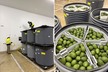
It is the first infrastructure of its kind in both Spain and Europe and has been the result of the commitment of the local company, MercaJúcar, to reduce the CO2 emissions generated by mushroom cultivation. The Albacete-based cooperative, which has been in operation for more than 10 years, carried out an expansion of its facilities and its need for thermal energy for heat increased. It is not surprising, considering they sell between 4 and 5 million kilos of mushrooms a year. That is why they decided to set up a solar collector.
It is called the Heliotube, it is of Austrian origin and it uses the sun to generate thermal energy. Taking into account its heat needs, the cooperative decided to bet on this infrastructure, which will allow it to reduce the consumption of other fuels, such as diesel and biomass, for water heating.
The Heliotube is a large cylinder; in this case, 200 metres long and 10 metres high, which concentrates the energy of solar radiation inside a chamber housed along its length, through which a fluid carrying the heat circulates. According to Antonio Sáez, manager of Villarrus, the Albacete-based engineering company that has served as liaison between the manufacturers and the cooperative, "the rays of the sun bounce and concentrate on a sensor that has a fluid inside which reaches a temperature of 230 degrees Celsius, and that energy is used to generate the heat," which, in this case, MercaJúcar needs for the production of its mushrooms; therefore, its primary energy source is solar.
Pilot experience at La Solana
The one set up in Albacete is currently the largest solar collector in the world, but it is not the first. A few years ago, in order to test the efficiency, operation and power generating capacity of the system, the manufacturing company, Heliovis, contacted the City Council of La Solana, in the province of Ciudad Real, where another one was set up ,but a smaller Scale: 80 metres long and 6 meters in diameter. "We wanted to evaluate its performance in an area where there was a high sun radiation," explains Antonio Sáez, and this municipality was the ideal place to do so.
He explains that the result of the test in La Solana was "very satisfactory" and this led to them considering the region as the ideal location to install solar collectors that are, as pointed out by the Villarrus manager, more advantageous in remote sites, where there are no electricity-generating facilities and where photovoltaic panels or wind turbines cannot be installed. It is ideal for "heat-consuming" industries, such as agro-food firms. In fact, and after this first experience in Villalgordo del Júcar, other companies in the country have shown their interest in using this solar collector to reduce costs and CO2 emissions in their production processes.
Source: eldiario.es