The minds behind the "A passo di Lumaca! Utilizzo di un antimicrobico naturale per il miglioramento della shelf-life di prodotti di IV gamma" project are three young students of Liceo scientifico Quinto Ennio in Gallipoli who, together with Professor Rossana Congedo, developed a snail slime extract which, combined with essential oils, can be used as an antimicrobial edible coating for fresh-cut products.
Left to right: Alessandro Bruno, Gabriele Mariello and Roberto Leone (Photo by Casati M.)
The experimental project was developed by Alessandro Bruno, Roberto Leone and Gabriele Mariello and was selected as a finalist of the 29th Italian selection of the European Contest for Young Scientists organised by the European Commission Joint Research Centre and promoted by FAST (Federation of Scientific and Technical Associations), which chooses the students worthy of representing Italy in the most prestigious international events. The contest is part of the "Io Merito" programme by MIUR.
Professor Rossana Congedo with her students (Photo by Bruno S.)
"The project was submitted to a jury made up of 30 experts from renowned international research centres. The students illustrated their study both in Italian and English and even offered the judges some fruit to taste," explained professor Congedo.
"Our project was chosen to represent Italy at the GENIUS OLYMPIAD 2017, the international competition which young scientists from 100 countries all over the world take part in. It will be held in Oswego (New York) between 12th and 17th June 2017."
Why using Helix aperta slime?
The beneficial properties of snail slime have been well-known since ancient times: it regenerates the skin and has mucolytic, antispasmodic, expectorant, fluidifying and antimicrobial properties. It's also rich in natural components such as vitamin A, C and E, glycolic acid, collagen, allantoin and elastin, sugars as well as at least 17 amino acids. What is more, it is abnormally resistant to pollution and can preserve tissue from freezing. Its anti-bacterial factor has a strong action against bacteria such as Bacillus subtilis, Staphylococcus aureus, Escherichia coli and Pseudomonas aeruginosa.
"Like all brilliant discoveries, this occurred by chance as well. We were savouring a dish made with Helix aperta snails, a typical Puglia dish, and discussing the beneficial properties of snail slime, when we thought about using it as a natural anti-microbial for food."
The project
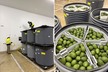
The first step was procuring the slime, which was extracted by stimulating the snails manually (photo by Bruno A.). The slime was then sanitised and subjected to various tests such as microbiological analyses, pH detection, heavy metal analyses, protein concentration, Minimum Inhibitory Concentration (MIC) detection.
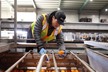
Once the extract was obtained, vegetables (salad, rocket, broccoli) and fruit (pineapples, strawberries and apples) were processed as fresh-cut products and coated with the extract. Samples were stored in polypropylene sterile containers at 5°C.
Comparison between broccoli treated with snail edible coating and untreated broccoli. (Photo by Bruno A.)
"Results were satisfactory and promising. The analyses and tests performed proved that non-coated samples showed signs of yellowing in case of green vegetables, a higher weight loss and bacterial load. Coated samples were also subjected to a sensory evaluation regarding aroma, flavour and texture."
Comparison between broccoli treated with snail edible coating and untreated broccoli. (Photo by Bruno A.)
"Results were satisfactory and promising. The analyses and tests performed proved that non-coated samples showed signs of yellowing in case of green vegetables, a higher weight loss and bacterial load. Coated samples were also subjected to a sensory evaluation regarding aroma, flavour and texture."
The snail slime coating proved effective in preventing deterioration and improving the storage of fresh-cut products and did not alter the organoleptic characteristics of the fruit. According to researchers, it could represent a safe, ecological and economical alternative to synthesised preservatives.
Roberto Leone reported: "this experience enabled us to get nearer to the world of research. The chance to formulate hypotheses and devise experimental procedures with the aim of finding something new and useful for everyone was very interesting! We learned how new ideas and perspectives can develop simply by talking."
Future perspectives
This coating could be improved further by adding natural aromas depending on the type of food (fruit, meat, fish, etc.). Vitamins, probiotics and nutraceuticals might also be added in the future. What is more, considering the excellent properties of snail meat, breeding and consumption could be promoted "also by producing small healthy and nutritious snacks."
The project caught the attention of the Istituto Internazionale di Elicicoltura in Cherasco (CN), which supported the students during the event in Milan and has already invited them to the international "Festival della Chiocciola" (Snail Festival), attended by around 30,000 people every year.
FreshPlaza wishes good luck to the students of Liceo scientifico Quinto Ennio in Gallipoli!