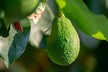
Avocado cultivation in the Canary Islands is expanding. In 2007, 815 hectares were devoted to the crop, and in 2015 this figure already stood at 1,287 hectares; a 58% growth that is testament to the boom experienced by this subsector in eight years and its potential for growth, especially as far as sales to foreign markets are concerned.
Spain is Europe's main avocado producer. Most of the production of the Islands has so far been used for domestic trade; however, the increase in the production is allowing for overseas sales to become more and more important, especially in the mainland market, but also in France and Cape Verde and other African countries.
La Palma and Tenerife are the islands where this crop has spread the most, with 595.3 and 473.4 hectares, respectively, compared to 181.6 hectares in Gran Canaria, 19.6 in La Gomera, 17 in El Hierro and 0.5 in Lanzarote.
A number of different avocado varieties are grown in the Archipelago. The main ones are the Hass and Fuerte, although there are also others, like the Antillano, Reed, Pinkerton, Bacon, Lamb Hass and hybrids of these. The combination of different varieties means that there can be production almost all year round, even though in summer, especially in August and September, it is smaller. The objective of the growers in the Canary Islands is to extend the harvesting season by growing the fruit in different microclimates.
Given these figures, the Councillor of Agriculture, Livestock, Fisheries and Water of the Government of the Canary Islands, Narvay Quintero, recently held a meeting with representatives of the cabildos of the islands where the cultivation is most significant, as well as agricultural organizations and producers. The meeting served to discuss the options available to producers to make the productions of the Archipelago stand out from those of their competitors, such as the adoption of European quality labels. "Betting on quality is the way for the Archipelago to strengthen its position against other productions that compete against ours (mainly in the south of the Peninsula) in the European market," commented Narvay Quintero.
Some of the tools growers resort to include the logo of the Outermost Regions (RUP), whose use in the Canary Islands must be authorised by the Canary Islands Institute of Agro-Food Quality (ICCA), or by applying for the granting of a Protected Geographical Identification (PGI), a European seal that other agricultural products, such as Canary bananas, are already profiting from. This must be requested by a producer organization and in order for it to be approved by the European Union it must be based on a specific variety with specific characteristics related to the geographical environment where it is produced.
Other issues of interest for the sector were addressed during the meeting, such as the aid in the framework of the Community Support Program for Agricultural Productions in the Canary Islands (POSEI), for which changes have been made in the line of external trade, which entails that the subsidies will be received by the producers instead of by the distributors.
There were also discussions on the work carried out by the Directorate General of Agriculture for the processing of a collective insurance for this crop, as well as on the request for an exceptional authorization for a phytosanitary treatment targeting nipaecoccus nipae (a pest affecting avocados), which is also useful against fruit cochineal (Fiorina fiorinae). Lastly, there were reports on the investments approved in the framework of the Rural Development Program (RDP), amounting to around 9 million Euro.
Source: valenciafruits.com