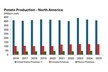
A few years ago, the storms that hit the Andalusian province of Seville during the potato harvest for two consecutive seasons took a toll on the results of the local sector. The markets thus opened up to the productions of the Region of Murcia as an alternative to the damaged Sevillian harvests. This partly explains why in the last two potato seasons for which we have official records (2014 and 2015), Murcia's harvest amounted to more than 175,000 tonnes and almost 162,000 tonnes, respectively; more than double the volumes recorded since 2009 and even four times as much as the approximately 40,000 tonnes harvested since the mid-90's.
"Many producers have been encouraged to plant more in Murcia, seeing that prices have been good for three years in a row," explains Lázaro Jiménez, manager of Multigestión en Agroservicios (MAS), a producer and marketer of this tuber. The entrepreneur explains that the bad results in Seville, where potatoes are an important crop, have motivated the growth in Murcia, but the improvement is also, above all, the result of a change of mentality.
In Murcia, potatoes have traditionally been planted as a secondary crop. It has served to fill the gaps left by the lands devoted to vegetables. Growers did not even care to grow the most interesting varieties for the market in each period, "but they planted any type of potato and then tried to sell it. Now, however, they are first selling and then planting what they know will be easily marketed, especially the exportable varieties," he points out. In short, the sector is becoming more prominent and professional.
"It is no longer planted, for example, when broccoli is harvested, as has been the case in the past, but whenever it is better for the potato itself. It is no longer treated as a secondary crop." The traditional patterns continue to be maintained, but the interest in the exploitation of the product itself continues to grow and with it the results. This has led to rising sales abroad, although Murcia's potatoes continue to be sold mainly in Spain. This is, according to Jiménez, the opposite of what happens in Andalusia, whose large plantations facilitate the tuber's export, since those customers seek to have guaranteed access to large volumes.
Source: laverdad.es