Iran is one of the leading producers and exporters of pomegranates worldwide, growing around 900 thousand tons per year on average and exporting over 150 thousand of them.
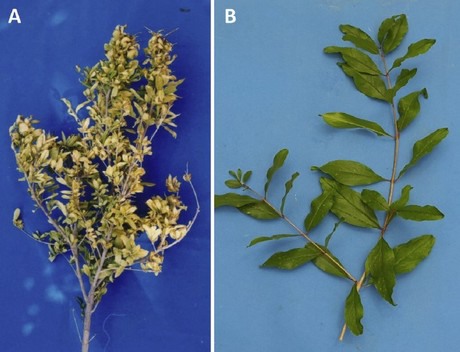
A) Pomegranate infected by PLL; B) Healthy pomegranate.
Between 2012 and 2014, various plants were identified as developing little leaves, i.e. the symptoms of a phytoplasma known as PLL (=Pomegranate Little Leaf), in many orchards in Khafr (KPLL) and Neyriz (NPLL) in the Fars province.
Iranian and Italian researchers have studied a few samples and found out that the nucleotide sequences of both strains (KPLL and NPLL) were identical and part of phytoplasmas group 16SrII, subgroup D.
In addition, the researchers explained that the strains analysed presented a 99% correspondence with a phytoplasma associated with the sesame phyllody phytoplasma infecting the fields near Jahrom.
In the Fars province, the sesame phyllody phytoplasma is transmitted by Circulifer haematoceps, therefore its role in the development of the PLL disease has yet to be established. This function is currently being analysed to study a better management of the disease and to prevent a critical situation arising. Researchers have concluded that it is the first occurrence of a phytoplasma part of the 16SrII group infecting pomegranates.
Source: Mohammad Salehi, Seyyed Alireza Esmailzadeh Hosseini, Rasoul Rasoulpour, Elham Salehi, Assunta Bertaccini, 'Identification of a phytoplasma associated with pomegranate little leaf disease in Iran', 2016, Crop Protection, Vol. 87, pag. 50-54. www.sciencedirect.com/science/article/pii/S0261219416300680
Contacts:
Mohammad Salehi
Plant Protection Research Dept., Fars Agricultural and Natural Resources Research and Education Center, AREEO, Zarghan, Iran
Email: [email protected]