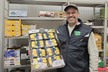
Ilenio Bastoni.
Apofruit's overseas sales have in fact largely increased this year: "especially in the Korean market," explains Bastoni.
Kiwis destined to the Korean market have the "Made in Blu" sticker.
The Psa situation
With regard to the "Psa situation", Fabio Marocchi and Marco Mastroleo, from the Apofruit Latina (Lazio) technical office, were asked for an opinion.
"We started noticing the typical white and red exudates two weeks ago. At the moment, it is not possible to assess damages. We will have to wait until the second week of April for that, though we can say that bacteriosis is mostly affecting those areas which have been previously subjected to it. This depends on the microclimate and on soil characteristics, as well as the capacity of farmers to carry out measures to control the disease."
Symptoms on kiwi plants.
"Finally, seasonal and weather conditions such as rainfall and frost have a huge influence. However, we will have to live with the Psa bacteria for a long time. We are confident producers will promptly apply a number of techniques."
On the basis of the very different climate and soil characteristics of the Latina area, technicians have come up with a series of recommendations, which can be summed up in four main points:
- Cleanliness: remove infected parts and renew the foliage if the infection is widespread
- Nutrition: it is fundamental to know our own soil and to create suitable nutritional plans in order to obtain a balanced plant. Be careful about deficiencies and maintain the balance between elements (especially calcium, potassium and magnesium), which are essential for a correct vegetative-productive balance to enable the plant to respond to external stress.
- Irrigation: water the plant using suitable systems and work out the quantity according to the phenological phase, in order to maintain the correct vegetative-productive balance and improve wood ripening.
- Prevention: use the most suitable aerial treatment according to the phenologial phase and to weather conditions. Prompt interventions are really important especially as buds are breaking, in the blooming period or after frost or infectious rainfall.
For more information:
Fabio Marocchi e Marco Mastroleo
Ufficio Tecnico Apofruit Italia
Stabilimento di Aprilia (LT)
Via Guardapasso snc
Tel.: (+39) 0692063704
Fax: +39 0692855418
Email: [email protected]
Email: [email protected]
Copyright FreshPlaza
Fabio Marocchi e Marco Mastroleo
Ufficio Tecnico Apofruit Italia
Stabilimento di Aprilia (LT)
Via Guardapasso snc
Tel.: (+39) 0692063704
Fax: +39 0692855418
Email: [email protected]
Email: [email protected]
Copyright FreshPlaza