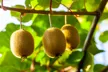
Passion fruit is currently in its winter peak in southern Florida. The state goes through two to three peaks a calendar year: December – January, May – June and occasionally August – September, weather permitting. “We’ve had very good supplies,” said Peter Leifermann with Brooks Tropicals. “We’re going to go for a couple more weeks with good volume.” Fruit will begin to lessen each week, then gap and pick up again in late May. If there’s a harder rainy season in late May that knocks the bloom off, there won’t be an August – September peak. “It’s hit or miss. There are so many micro climates, depending on which grove gets hit with rain or if there’s rain throughout / wet first half of the summer that has a lot to do if you’ll be getting that crop 60-90 days later.”
Brooks Tropicals’ varieties are particularly developed for the Floridian environment, made to withstand the humidity and temperature compared to the varieties grown in New Zealand, Africa, Columbia and even in the state of California which Leifermann says are more suited for a drier environment with cooler temperatures.

Promotion can be difficult on a commodity like passion fruit. “It can be difficult even two weeks out regardless of the seasonal peak (winter or summer) because it’s a tough crop to assume quantities and even tougher to assume quantities by size,” he said. “We learn more every year, but we’re also developing new varieties. On any given crop we may have all of one variety or we may have three or four different varieties being harvested. Our vines typically don’t get worked more than four years at most. Sometimes it’s a short as two years.” The varieties that produce larger fruit are gaining acceptance because of their value in the amount of ‘meat’ it has. Leifermann says there’s value typically in sizes such as the 30 series – 30, 32, and 36. “While that’s still popular we’re getting headway with our larger size fruit.”
Piggybacking on the coattails of larger beverage companies has been something Brooks Tropicals has taken advantage of. “Passion fruit is an ever increasing component of fresh fruit smoothies, juices, recipes, cooking. As processed foods introduce the flavor profile of passion fruit to the public we’re able to reinforce it with the fresh fruit.” Of the approximate overall 100 acres of passion fruit grown in Florida, roughly 50 acres is managed by Brooks Tropicals.

The biggest challenge is getting an accurate projection of crop size. “That’s due to the variability of weather. Passion fruit is a true tropical specialty. As good as we are at doing tropical – it’s what we’re known for – passion fruit is still not something that can be ‘programmed’ like a banana,” Leifermann said. “The biggest challenges are the crop variances – and Mother Nature. We manage it by being in the fields every day, we act as fast as possible. It’s picked and packed and on the road generally within 48 hours.
Peter Leifermann
Brooks Tropicals, LLC.
Tel: 877-775-3752