The asparagus market in Mexico is undergoing a period of transformation driven by rising production costs, water scarcity, and the need to improve yields. In this context, hybrid seeds, particularly 100% male varieties, are becoming more popular than traditional open-pollinated types.
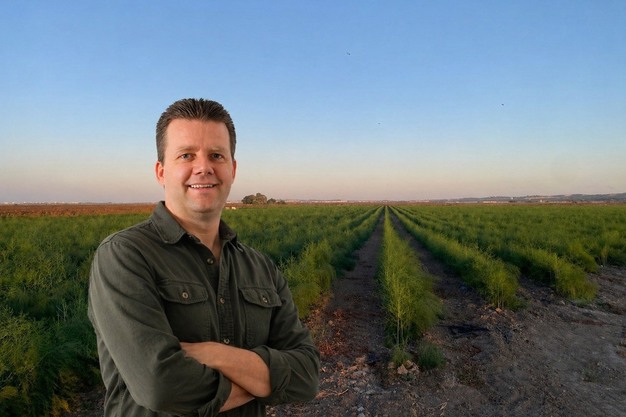
Jan de Lange, general director of Inversiones Nedmex and the exclusive distributor of Limgroup in Mexico, states that "if a grower keeps using the same variety, his profit margin is likely to decline," especially as costs for fertilizer, energy, and logistics continue to rise.
 © Inversiones Nedmex
Limgroup is a Dutch company that specializes in breeding and seed production for only two crops: asparagus and strawberry seedlings.
"We have been developing new asparagus varieties since 1958. Currently, we offer 19 commercial varieties, export seeds worldwide, and hold a 75% market share in Europe. Additionally, all our seeds are packaged in our own packaging, which ensures the quality of our seeds and varieties," he said.
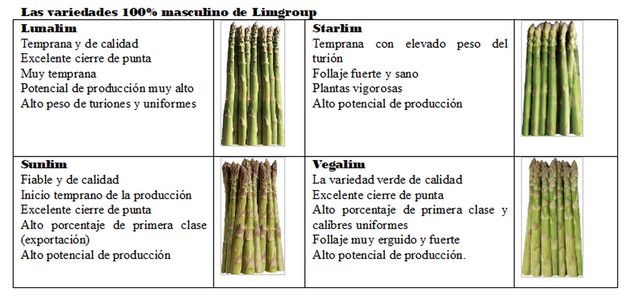
"We currently offer four varieties suitable for Mexico and other Latin American countries: Lunalim, Starlim, Vegalim, and Sunlim. Lunalim is the earliest variety, requiring fewer cold hours to harvest. In contrast, Vegalim is a later variety that needs more chilling hours. An added benefit of Vegalim is its foliage's ability to withstand strong winds," he emphasized.
Hybrid varieties are positioned as an important alternative to sustain profitability. "Our varieties yield at least 50% more than those currently on the market," says De Lange. This difference stems from the fact that hybrid plants do not produce seeds, allowing them to focus all their energy on growing the shoot (stem), thereby enhancing productivity and uniformity.
In addition to yield, input efficiency is another determining factor. "While traditional crops may need up to 160,000 plants per hectare, hybrid varieties lower this number to about 20,000, directly influencing costs. Feeding three children is much more expensive than feeding just one," he stated.
The shift to hybrids also reflects a structural evolution in the sector. "A grower who switches from traditional varieties to hybrids never goes back," stated De Lange, drawing a parallel with the historical transition in other crops, such as maize.
Mexico continues to rely heavily on the U.S. market for trade, making it its primary export destination, with Canada, Europe, and Japan following. The country's competitive edge largely stems from its logistical closeness to the United States. "When Mexico and Peru access the same market, Mexico benefits from lower logistics costs," he stated.
However, climate and water availability continue to pose significant challenges. "If there is no water, we automatically face trouble," he warned. Regions like Sonora, Guanajuato, and Baja California account for about 98% of the national production due to favorable conditions that offer better irrigation control.
In the coming years, the sector aims to adopt more technology and genetics. For De Lange, the future is clear: "The big difference in competitiveness will come from the choice of varieties."
 © Inversiones Nedmex
 © Inversiones Nedmex For more information:
Jan de Lange
Inversiones Nedmex
Mexico
Tel: +52 479 136 3291
Email: [email protected]
www.limgroup.eu