Chef robots can automate tray assembly for produce packing. This includes placing discrete items such as whole fruits like oranges, apples, and pears into clamshell packages and snack boxes, and portioning scoopable ingredients such as corn and peas into trays before packaging. These applications support retail grab-and-go products, airline meal kits, hospital and care facility meals, and school lunch boxes.
Produce packing automation presents technical challenges. Unlike grains or sauces, whole fruits and vegetables are rigid, irregular, and vary in size, surface texture, and placement in a bin. These items are packaged in containers such as retail clamshells, snack boxes, and portioned meal trays, which require consistent placement and presentation. This has made it difficult to handle produce items reliably at production speeds.
 © Chef Robotics
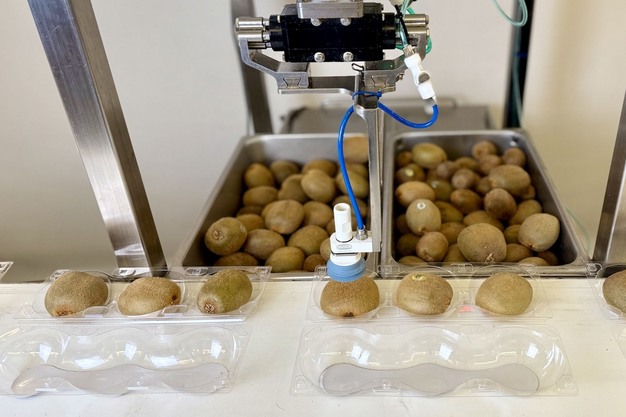
Chef's AI-powered food robotics addresses produce packing using two capabilities, piece-picking and scooping, depending on the ingredient. For discrete items such as whole fruits, including oranges, apples, kiwis, and pears, the piece-picking capability uses computer vision to assess each item's position, shape, and orientation in real time, enabling the robot to determine how to pick and place it into the tray. For scoopable produce such as corn and peas, the scooping capability portions ingredients by weight and places them using a tray-tracking vision system.
Packing produce requires more than picking and placing ingredients into trays. Depending on the SKU, operators may need items to land in specific positions, fill a tray in one pass, or stack items to increase pack density. To meet these requirements, three placement methods are used.
Offset placement uses a camera system to identify the center of each tray or clamshell, which acts as a reference point for placing each item. The robot positions each piece at a set distance from the center. For example, in a pack with three pieces of fruit, the first item can be placed in the middle, the second to the left, and the third to the right, ensuring uniform presentation regardless of tray position on the conveyor.
Multi-item tray assembly allows robots to place multiple pieces of fruit into the same container in a single step, completing the assembly without manual intervention between picks.
Stacked placement is used for deeper trays, where produce is arranged in layers. For example, if a tray holds eight items, the robot places four in a bottom layer and four on top, stacking them to maintain structure while limiting damage.
Workers have traditionally staffed produce packing lines to sort, place, and fill items by hand on fast-moving conveyors. This repetitive work can make staffing less consistent. Robotic packing and clamshell packaging automation can reduce this reliance. The system operates on existing robotic hardware and software, allowing food manufacturers to deploy it without changes to production lines.
For more information:
Chef Robotics
Email: [email protected]
www.chefrobotics.ai