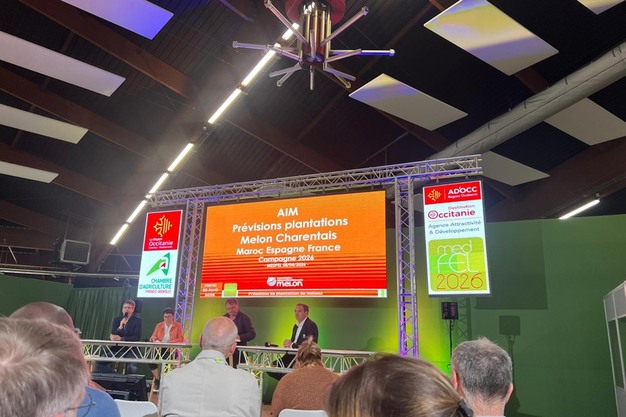
This week at medFEL, the Interprofessional Melon Association presented its annual planting forecasts for Charentais melons. While the year 2025 was marked by a general decline in acreage, the 2026 campaign is beginning to see a certain rebalancing (in Spain and France), but is still very much affected by the vagaries of the weather. This is also an opportunity to look back at the work on varietal improvement that has been underway for several years to meet consumer expectations.
 © FreshPlaza
Morocco: Particularly difficult production conditions
In Morocco, the campaign has been marked by particularly difficult production conditions, with a reduction in the number of active basins. From four previously, the country is now down to three with the closure of the Kénitra site (-120 ha).
In Marrakech, the surface area remains stable at around 800 hectares, 95% of which is planted with Charentais melon, mostly under cover. The same trend is seen in Agadir (85 ha, with mainly green Charentais). In both those areas, planting in greenhouses, which began in December, enabled crops to be harvested from early April to May, with quality judged to be satisfactory.
Outdoors, the situation is more complicated, due to the lack of heat, heavy rain, late planting, and uneven development. These conditions are causing a delay in harvesting, lower yields, and a production peak not expected until mid-May. There will also be a gap in production between greenhouse and open field volumes.
Further south, the Dakhla basin has been hit hard. A sandstorm in December caused major damage to greenhouses, leading to a sharp drop in melon acreage of up to 80%, with some farms switching to tomatoes. The harvest, which began in March, is now almost complete.
In all, Morocco has seen a drop of around 200 to 1,015 hectares, a reduction that has been described as "brutal." "Dakhla is almost finished, as is Agadir, and we are essentially left with Marrakech, where yields are very low because of the weather conditions. All of this explains the glaring shortage of melons on the market, with planting and harvesting being delayed and having a direct impact on yields," according to the Interprofessional Melon Association.
Spain: stable acreage
In Spain, acreage remains stable overall, at around 2,500 hectares. By basin: Seville is holding steady at around 390 hectares, mainly in yellow Charentais, Almería at 270 hectares in green Charentais, and Murcie-Alicante at around 1,700 hectares, with around 80% of green Charentais.
However, the campaign was marked by disrupted weather conditions. Seville was hit particularly hard by bad weather and flooding, while the Murcia and Alicante basins also experienced rain, but with a more limited impact. These hazards led to plot adjustments, including a partial transfer of plantings from the Murcia region to Alicante.
Despite these disruptions, the areas have been planted by now. The open field is due to start around May 8-10th, with significant volumes expected from May 20th onwards. As a result, the Spanish campaign is broadly stable, albeit slightly delayed by the weather.
France: "The weather has had a particular impact on the southwest over the past three years"
In France, the downward trend continues in the southwest, where acreage is once again down by around 100 hectares, falling below the 2,000-hectare mark for the third year running. In the southeast, the decrease remains more limited (-80 ha), with 5,720 hectares, while the center-west is stable at around 2,300 hectares.
In terms of growing conditions, rainfall in the southeast of France disrupted early planting, leading to delays. To date, however, all planned plantings have been completed. In the center-west and southwest, field entry conditions have been good overall. However, the issue of water resources remains a source of concern. "The southwest has been hit particularly hard by the weather over the past three years, with winter and spring conditions that do not bring peace of mind to producers and make it more difficult to implement strategies," according to the Interprofessional Melon Association.
"In the southeast of France, we are up to date, and even well advanced. The very early field plantings are a fortnight late, but the first sets are underway. We should start with very low volumes around June 5th," according to the association. One point of vigilance, however, concerns the regrouping of plantings over a short period of two to three weeks to make up for delays, which could complicate market management.
Organic acreage remains stable at 7.5%. While the specialist market seems to be picking up, this has not yet been reflected in supermarkets, the main outlet for organic melons. "This may be why the market has not really picked up yet." Against this backdrop, there has been no change in the area under production.
"Today, the disappointing side of melons has all but disappeared"
The interprofession continues to work on raising the profile of French melons, with the aim of ensuring that consumers recognize their quality. This approach is based in particular on the work on varietal improvement carried out over several years, from selection through to production. These efforts are bearing fruit. "Today, the disappointing side of melons has all but disappeared." As part of this drive, the association is currently working on the introduction of a quality charter designed to enhance the value of the work carried out in production.
At the same time, the interprofessional group has conducted a two-year study with CTIFL to assess the match between the varieties on offer and consumer expectations. The aim was to gain a better understanding of supply and demand. The result: a 92% satisfaction rate, proof that "consumers really like melons." When it comes to the criteria that determine the decision to buy, smell comes first. "It is what makes consumers want to buy." Visual appearance comes second, followed by origin. Price, for its part, does not appear to be a decisive criterion in the act of buying. Finally, in terms of appreciation criteria, flavor takes precedence over sugar content." The sugar content is important, but the aromatic aspect of Charentais melons is essential."
Phyto technical network set up
For the second year running, the Interprofessional Melon Association is stepping up its efforts by setting up a phyto technical network. The aim is to ensure the long-term viability of the French offer against a backdrop of increasing pressure on production: rising input costs, unstable weather conditions, changes to specifications, and a reduction in protection solutions.
The network aims to improve technical monitoring and facilitate the exchange of information between producers, technical institutes, firms, and government departments, in order to better anticipate production problems.