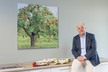
"We have the confidence to 100% guarantee our clients' delivery, barring force majeure," begins Wim Kleinjan, CEO of Fruity Pack. That is because of the new strategy this Dutch fruit and vegetable processor implemented after the COVID-19 pandemic. Wim explains that the restrictive measures placed on the foodservice sector during that period turned their expected 20% revenue growth into a 50% loss. These days, the company generates 200% more income than before the pandemic.
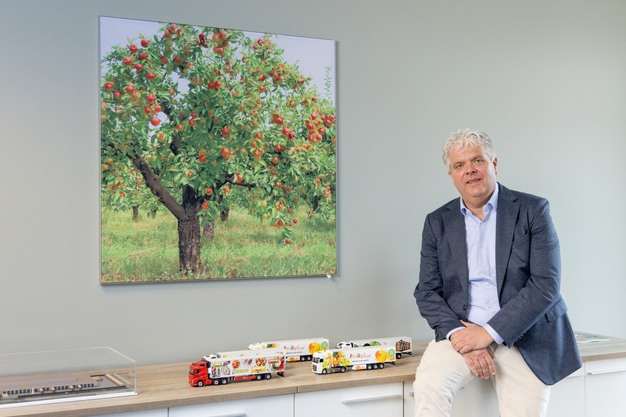
Wim says this development is based on restructuring their supply chain. The business used to rely heavily on importers; now, its focus has shifted to direct collaboration with growers worldwide. "We currently source around 95% of our raw materials directly." Along with that, they have multi-year agreements on volumes and prices, which gives growers clarity. Also, they can cultivate crops specifically tailored to the processor's specifications, Wim points out.
 © Fruity Pack
Supply continuity
"Being closer to the source means we can respond faster and have a better overview of availability and logistical developments," he says. According to Kleinjan, that is crucial in a market where geopolitical tensions, climate change, and transport chain disruptions are increasingly causing uncertainty. "This supply chain optimization contributes to supply continuity, allowing us to offer a delivery guarantee."
That strategy means Fruity Pack is outgrowing its current location. "We've now reached maximum capacity. To keep delivering our products fresh daily, rather than from stock, we must significantly increase our factory's capacity. The winter slump is almost over, and fruit always generates the most revenue in Q2 and Q3. We, thus, use those volumes as the basis for our fresh daily production," Wim explains.
New building
To support further growth, the company is expanding its production capacity with a new facility that will begin operations in mid-2026. "The 6,000 m² expansion will be separate from the current building. We can, thus, start in the new production facility, and only once everything is fully operational will we connect the two production sites and implement sustainability improvements in the existing facility. Our customers won't be inconvenienced by the transition to the new building."
The new facility has room for further automation, too, which, says Wim, is essential to offset rising wages. Those are due to factors like changes in labor legislation and the treatment of temporary workers. "The sector is labor-intensive, but where possible, we want to streamline processes. This shift to capital-intensive operations requires significant investment," he explains.
"Our family business can, fortunately, handle that without external financiers or private equity firms," Wim adds. The goal of these investments is to keep costs under control. "Labor costs have skyrocketed and should rise even further. We want to use this automation to do everything we can, cost-wise, to keep price increases to a minimum," he continues.
 © Fruity Pack
Extensive distribution network
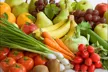
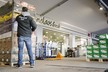
Aside from production, logistics is central to Fruity Pack's supply chain optimization, and the fruit processor has built an extensive distribution network. "Our 35 trucks deliver to distribution centers and stores in the Netherlands and Belgium every day." The company also offers the option to order by consumer unit (CU), the CEO says. "We pick our entire product range into mixed crates. That ensures minimal waste in stores and the best freshness guarantee," he says.
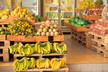
To support that, a field service team visits stores and advises on aspects like ordering patterns and shelf layouts. Fruity Pack also acts as an extra set of eyes on quality, Wim notes. "We've developed a special app where every comment from both our field service team and customers goes directly to the production managers. So, we've made the supply chain incredibly short and can guarantee maximum quality in stores."
Expanding the range
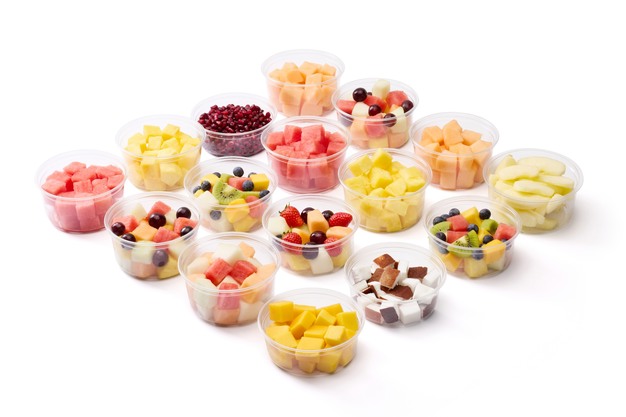
Range expansion is another part of the new strategy. The company, for instance, is exploring new convenience concepts for different consumption moments. "That includes poké bowls, lunch salads with clean-label positioning, and new uses combining fruit and other ingredients. One example is the introduction of fresh chocolate-coated fruit, such as chocolate-coated grapes. This product has long been available in the frozen segment, but is now being produced fresh, and we're currently testing it at the store level," Wim notes.
A key element of the new facility is further specialization regarding fruit, Wim adds. The company is investing in facilities, such as ripening rooms for mangoes, to improve the quality and uniformity of ready-to-eat fruit. "Mangoes are one of the most challenging fresh market products. By spending money on new technologies, we can make significant progress here." Work on facilities for processing pomegranate seeds is also underway. "Besides those flown in daily from India, we're going to launch our own line of pomegranate seeds transported by sea," he reveals.
"Buyers can then choose to avoid air freight." Kleinjan also says the vulnerability of that mode of transportation is a factor. "With all the recent geopolitical unrest, both the prices and availability of pomegranate seeds are under pressure. We've managed to deliver every day, but sea freight offers more certainty. By setting up our own processing, we're less dependent on air freight and can better address concerns regarding CO₂ emissions and supply security," he points out.
Exports
Along with the potential of high-quality mangoes and pomegranate seeds, Wim sees expansion opportunities in the local as well as export markets. "We supply retailers and foodservice clients in various European countries, including Scandinavia, Germany, France, Belgium, and Austria. Our location in Rotterdam allows us to serve much of Northwest Europe within 24 hours."
 © Fruity Pack
"There is a growing demand for convenience and healthy snacks, and we see room for further development," Wim elaborates, but, at the same time, there are ongoing challenges surrounding the climate, logistics, and cost trends. "With the new facility and our investments, we want to gradually prepare our family business for the next generation."
Fruity Pack, therefore, has its sights set on the long term. "The next generation is already active in the company and is increasingly taking the lead in daily operations. I, however, hope to remain active as part of the current generation for many years to come. Our new facility and investments mean we're ready for the future. We want to do even better tomorrow than we did today," concludes Wim. (MW)
For more information:
Fruity Pack B.V.
Tel: +31 10 303 5100
[email protected]