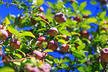
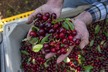
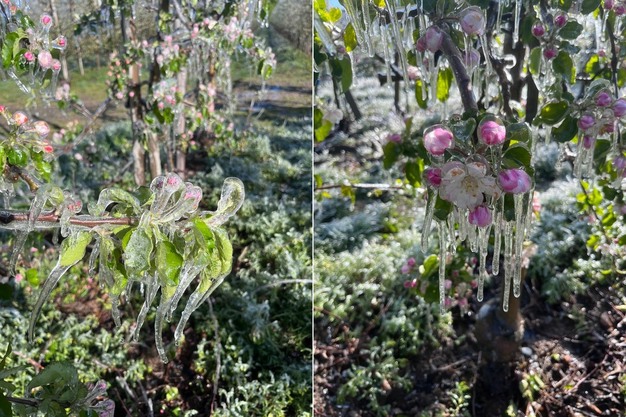
This year, Polish orchards experienced more of a typical winter frost rather than short, early-morning spring frosts, says Adam Malengiewicz, owner of Polish apple trader AD Fresh Nature: "In previous seasons, spring frosts usually began around 2–3 a.m., with temperatures briefly dropping to around –3°C or –4°C. This time, however, we had four consecutive nights of severe frost, with temperatures falling below 0°C as early as 10 p.m. In some regions, temperatures dropped as low as –9°C. In our own orchard, the coldest night reached around –5°C. Conditions varied significantly across the country, and not all orchards were affected equally."
 © AD Fresh Nature
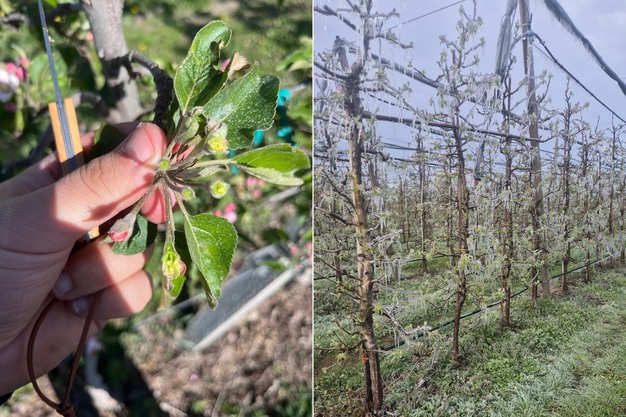
According to Malengiewicz, the frost has had an impact on both the quality and quantity of apples. "While it's clear that next season's harvest will be lower than in the previous year, it's too early to provide precise figures. More reliable estimates may be possible at the beginning of July, with final results known only after harvest. At this stage, many flower buds show signs of damage, but the extent differs greatly depending on apple variety, orchard location, and the use of frost-protection measures. Hopefully, there are no further frosts ahead. We are keeping our fingers crossed that we can avoid any additional weather-related challenges."
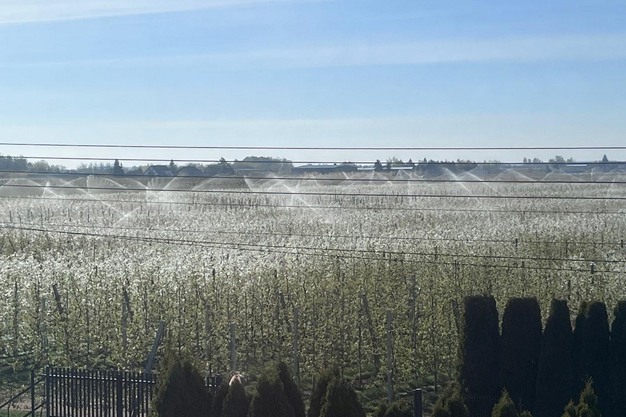
"Our company itself is mainly focused on sales cooperation, but together with my family farm and neighboring growers, we work closely with production. We have invested in several frost-mitigation measures to reduce potential damage," Malengiewicz continues. "We primarily rely on three methods: overhead irrigation systems, controlled small fires in the orchards, and fogging to create a protective layer over the plantation. Among these, irrigation is generally the most effective and well-known protection method. However, access to sufficient water remains a major challenge in Poland. During severe frost events, limited water availability can reduce the effectiveness of this approach, particularly for sensitive varieties such as the Jonagold group."
 © AD Fresh Nature
"Other methods, such as orchard heating with candles or small fires and fog creation, proved ineffective when temperatures dropped to extreme levels, such as –9°C. However, when minimum temperatures were closer to –5°C, and we managed to raise the temperature by even 2–3°C, these measures sometimes helped to reduce frost damage, even if they did not fully prevent losses."
 © AD Fresh Nature
Malengiewicz expects blueberries to have suffered a lot less from the frosts, which is a product AD Fresh Nature also exports: "In our company, apples remain our leading product and the most frequently discussed item. However, around 10/15 years ago, many local growers transitioned from apple production to blueberry cultivation. As these plantations are now reaching maturity, we see strong potential for the export of Polish blueberries. The frost mentioned earlier also affected blueberries, but far less than apple orchards due to the different stage of flower development. While we do not expect record blueberry yields this season, the export potential during and after harvest remains solid, and we are confident in our ability to supply customers across Europe," Malengiewicz concludes.
For more information:
Adam Malengiewicz
AD Fresh Nature
Tel: +48 576 069 240
[email protected]
www.adfreshnature.com