York-based agri-tech firm, AgriSound, launches a European field trial with international food group, Importaco, to measure how regenerative farming affects pollination and crop performance in almond orchards.
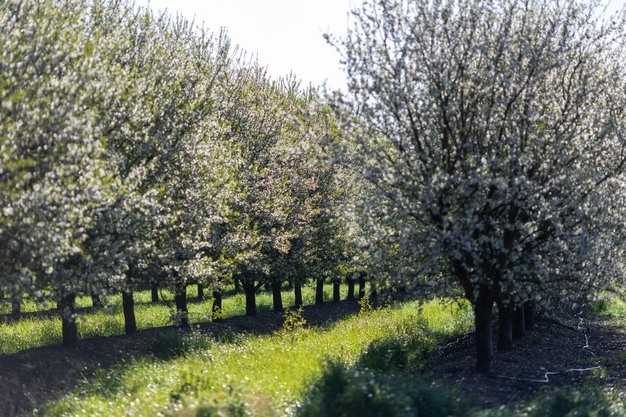
The 2026 bloom season pilot sees AgriSound's Polly TM monitoring technology deployed across two commercial almond production sites in Spain and Portugal, capturing real-time data on bee activity, pollination performance, and crop outcomes.
The project with Importaco, specialized in the production, processing, and distribution of nuts, dried fruit, and mineral water, is developed in line with the company's commitment to promoting agricultural practices aimed at protecting biodiversity, and with the pathway undertaken across the value chain towards decarbonisation.
 © Importaco
By directly linking pollinator performance to nut set, yield, and quality, the trial aims to provide commercial evidence of how regenerative farming practices affect both biodiversity and productivity in tree nut crops.
More than 120 field sensors are installed across the orchards. AgriSound's PollyTM monitoring devices are deployed at two sites: Zurria, Spain, a 50-hectare orchard, and Freixo, Portugal, a 23-hectare site.
The trial evaluates pollination performance by tracking hourly bee activity, generating field-wide heatmaps, and monitoring hive dynamics during bloom. It also assesses crop outcomes, analysing nut set, yield, and quality to quantify return on investment. Biodiversity and regenerative impact are measured by comparing pollinator activity across habitats and management systems, while operational insights focus on identifying underperforming orchard zones and linking pollinator activity to yield and quality.
Sensor deployment is tailored to orchard geometry to ensure full spatial coverage. Zurria uses a wider hexagonal grid across uniform blocks, while Freixo applies tighter spacing across smaller plots to prevent pollination gaps. Devices are positioned to avoid end-of-row microclimates and ensure representative monitoring.
Casey Woodward, founder and CEO of AgriSound, says: "Pollination is one of the most important, yet least measured, drivers of crop performance. By working with Importaco across both regenerative and conventional almond systems, this pilot allows us to directly link pollinator activity with real crop outcomes such as nut set, yield, and quality.
"The goal is to generate robust, independent data that helps growers and food companies to understand where regenerative practices are delivering measurable benefits, while also demonstrating how precision monitoring can support more resilient and productive orchard systems at scale."
Lucia Donnini, Director of Agricultural Science at Importaco, adds: "Importaco is committed to advancing sustainable and regenerative agricultural practices across our supply chains, and understanding the role of pollinators is a key part of that journey.
"Partnering with AgriSound gives us an exciting opportunity to apply vital monitoring technology to our almond orchards and generate the robust, data-driven insights needed to better understand how pollination influences both biodiversity and crop performance. We look forward to working together to demonstrate how innovation can support healthier ecosystems while delivering strong outcomes for growers and food production."
 © ImportacoFor more information:
Importaco
Tel: +34 96 122 30 00
Email: [email protected]
www.importaco.com