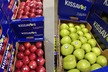
There are still quite a few apples in stock across European countries, says Matoula Katsika, export and sales manager for Greek fruit exporter A.C. Kissavos: "Since November, the apple season has moved through a few clear phases globally, but relatively stable. There were some pressure points; the market was a little more subdued in terms of demand for our products. The New Year records showed increased apple stocks, at least in Europe, led by Italy and Poland. There was a market pressure period between January and February, where prices softened in several markets."
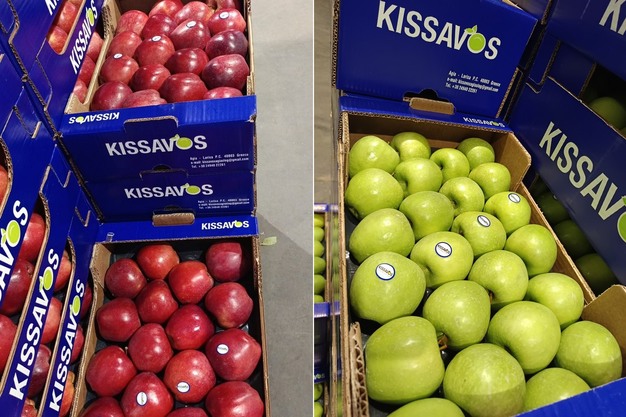
According to Katsika, certain export markets were still very much active. "There is strong competition from Italian and Polish apples, and we see a slower demand in parts of the Middle East and Asia. Export markets like India and the United Arab Emirates were still active, but more price-sensitive, and buyers had to push for better deals. Right now, in late March, the availability of apples in Greece is generally good, but not abundant across Granny Smith and Reds. It's a typical mid–late storage season situation."
 © A.C Kissavos
The current situation in the Middle East is a real challenge for an exporter like Kassavos, Katsika explains: "Because we work mostly with all countries of the Middle East, the current situation is a problem. The region suddenly became a high-risk one, and shipping routes are disrupted, like the Strait of Hormuz. There are delays in the transit time, which has increased transit time by more than 10 to 15 days in some cases. On top of that, the freight cost, with the war risk insurance, became extremely high. Finally, and most importantly, we have a higher risk of quality loss."
The alternative to these higher costs and longer transit times is either to hold the stocks or to change the export market, Katsika states. "Some exporters are holding stock instead of shipping, and others are redirecting their fruits to alternative markets until things stabilize. In practical terms, for our season, it means a slower export flow, while stocks remain higher and the prices are under pressure. Meanwhile, we're slowly cruising towards the end of the season."
 © A.C Kissavos
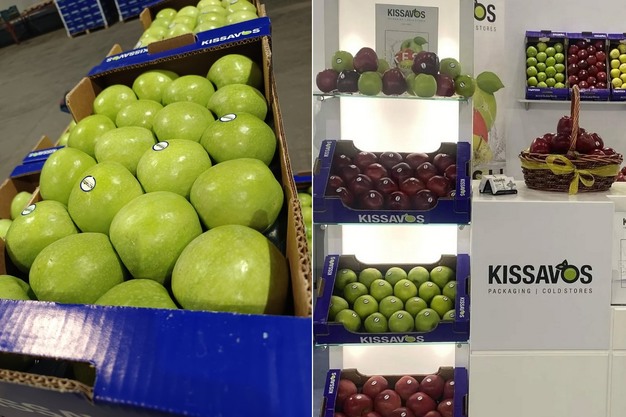
The market is mostly focused on getting the right price for the apples, Katsika emphasizes: "Global apple demand is growing slowly but steadily. However, buying behavior has changed to be more focused on price sensitivity. As such, demand exists, but it's selective, not broad. We do see new opportunities in Asian markets, like India, Malaysia, and Singapore. Also, the Balkan countries and European markets in general have become more interesting, because these regions are closer to us. The war doesn't cut the demand out completely, but it has changed our destinations."
"Despite current challenges, the apple market continues to offer solid opportunities for well-positioned products. With consistent quality, reliable supply, and a clear understanding of market needs, as suppliers, we can still achieve strong results across both premium and volume segments," Katsika concludes.
For more information:
Matoula Katsika
A.C Kissavos
Tel: +30 24940 22261
Email: [email protected]
https://kissavosgroup.gr