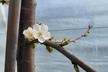
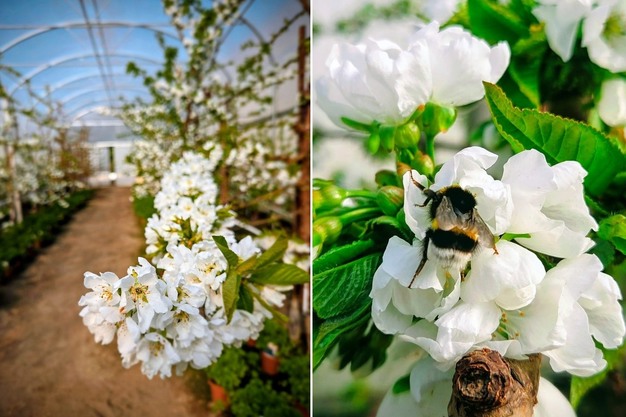
These days, the cherry trees at Amelinckx Fruit are almost fully in bloom. Now it is a matter of waiting to see whether the blossoms are well pollinated and can develop into full, tasty, juicy 'CherryLou' cherries, says Katrien De Backer, whose parents run the business together with her uncle Jos Amelinckx, and who herself works in the fresh produce trade. "Lou is our son's name, and the cherries are named after him."
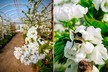
The trees on the farm are grown in plastic greenhouses that can be fully closed during cold nights and opened at the sides for ventilation to allow the crop to dry quickly in the morning. "The recent light-rich days, with warm sunshine, have encouraged the bees and bumblebees to leave their nests more easily," Katrien explains.
 © Amelinckx
"It is not always straightforward to get enough pollinating bees onto your blossoms. The climate, both outside and in the greenhouse, plays a major role. You need to have enough open flowers before placing the hives in the greenhouse; otherwise, you will need to supplement the hives. The health of the hive is also a top priority. Our beekeeper, Beeworld, puts great care into keeping these pollinators in top condition year-round, day in and day out. We have a wonderful partnership, we have blossoms, they have bees."
"Together, this creates a beautiful and fruitful symbiosis of cherries and 100% natural cherry blossom honey, as these bees have flown exclusively on cherry blossoms. This makes the honey a unique product within their range. That's what you call teamwork," she laughs.
"Thanks to Rovero, all our cherry trees are covered, and the advantages are many: protection against cold, frost, precipitation, extreme heat, insects, birds, and diseases. This also significantly reduces the need for plant protection products, allowing us to meet the 'baby standard'. Water and nutrients are supplied through drippers at the base of the trees, keeping the crop and cherries clean and dry."
Mid-May to the end of July
Moreover, the fruit remains dry during rainfall, allowing the cherries to stay on the tree longer and continue to develop. "This way, they gain extra sugar and size," she says. She adds that this also allows the season to be spread more evenly. "Thanks to the plastic covering, temperatures rise more quickly, enabling us to start sales earlier and even extend the season when outdoor cultivation faces climatic challenges."
As a result, the company now grows eight different varieties. "We have chosen to plant more early varieties. The greenhouse effect, combined with these early varieties, means we can now usually start production as early as mid-May. In terms of varieties, we grow Nimba, Samba pollinator, Kordia, Merchant Noire, Areko, Carmen, Starblush 'Wittebuik', and Papillon 'Wittebuik'. These range from light red to dark red, including white-bellied varieties with a pink blush, and from soft and juicy to firm, crisp types. This spreads our season from mid-May to the end of July."
 © Amelinckx
As a result, activity at Amelinckx Fruit is already well underway. "Everyone in the family is busy in the greenhouses preparing for what we hope will be a great season. If pollination has gone well, we will once again do everything we can to bring delicious local cherries to consumers. We are a small-scale family business, but we aim to do everything ourselves with care. If something does not go as planned, we can only blame ourselves. Still, I believe you can truly taste the flavour of the past in our cherries."
Asparagus is coming
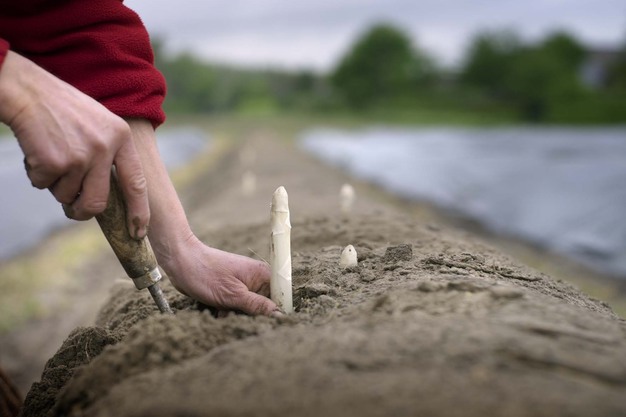
The asparagus season is also now getting underway. At Amelinckx Fruit, asparagus is gradually starting to emerge. "With Easter approaching, there is already a sense of anticipation. We began the season a fortnight ago with almost 'summer-like' temperatures, although cooler weather is expected again in the coming days."
For more information:
Amelinckx Asperges & Fruit  Queen Astridlaan 171
2880 Hingene, Belgium
Tel: +32 (0) 475 26 99 15
[email protected]
www.topasperges.com