The war in Iran has virtually halted all export and import flows between the country and its trading partners. For the EU, Iran is not a major partner in fruit, vegetables, and nuts. Imports from Iran account for only 0.6% of total European imports from third countries.
Nevertheless, the 27 EU member states imported more than €225 million worth of fruit, vegetables, and nuts (Chapters 07 and 08 in the Harmonized System) from Iran last year. These imports consist overwhelmingly of fruit and nuts, at approximately €210 million, or 93% of the total. Vegetables account for around €15 million, according to preliminary Eurostat figures for 2025.
Pistachios completely dominate the picture
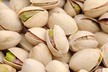
Looking at import flows at the product level, one product clearly stands out: pistachios. With an import value of more than €112 million, shelled pistachios represent nearly half of European agri imports from Iran. Pistachios in shell account for €6.7 million.
Second place is held by sultanas, with around €54 million, followed by dates at nearly €28 million. This trio, pistachios, sultanas, and dates, forms the backbone of Iranian agricultural exports to the EU.
Smaller, but still noteworthy, are truffles at more than €10 million. There are also limited volumes of watermelons, shelled almonds, cherries, figs, and dried apricots.
Germany, by far the biggest buyer
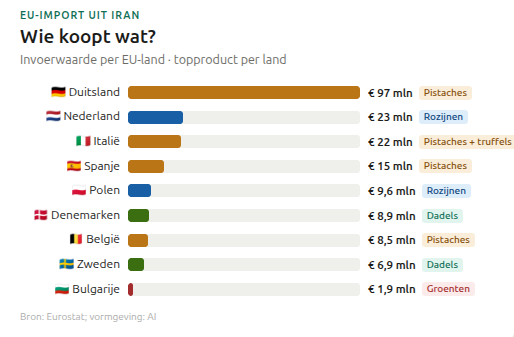
Germany is by far the largest importer, with a total import value of nearly €97 million from Iran. This is more than four times the value of the second-largest importer. The Netherlands' role as a European trade gateway is also evident, ranking second with more than €23 million, followed by Italy (€22 million) and Spain (€15 million).
Other relevant importers include Poland (€9.6 million), Denmark (€8.9 million), Belgium (€8.5 million), and Sweden (€6.9 million). Bulgaria stands out as the largest importer of vegetables, with nearly €1.9 million, likely supported by geographical proximity and cultural ties to the region.
 © FreshPlaza
Pistachios dominate imports in Germany, Spain, Italy, and Belgium. Sultanas are the leading product in the Netherlands and also play a major role in Poland and other markets. Dates are the main product for Denmark and Sweden, while truffles are primarily destined for Italy.
EU exports modest quantities of vegetables to Iran
EU exports of vegetables, fruit, and nuts to Iran are limited, both in volume, at barely 0.04% of total fresh produce exports to third countries, and in the number of countries and products involved. Trade mainly consists of niche products such as seed potatoes and dried pulses, with France and the Netherlands as the main exporters.
A total value of €5.9 million is involved, of which the vast majority, nearly €5.8 million, consists of processed vegetables. Fruit and nuts are virtually absent, with only €137,000 recorded. Since imports from Iran to the EU exceed €225 million, the trade balance is highly asymmetric.
At the product level, one category stands out in exports to Iran: dried vegetables and vegetable mixes account for more than half of fresh produce exports, at nearly €3 million. These are supplied by France, Hungary, Bulgaria, and Germany. Seed potatoes are also a notable export product, supplied entirely by the Netherlands.
Only a limited number of EU countries export significant volumes to Iran. France leads with €1.86 million, followed by the Netherlands (€1.6 million) and Hungary (€732,000). Bulgaria, Italy, Germany, the Czech Republic, and Spain are also active, while the remaining 19 member states export virtually nothing to Iran in this category. Trade in agricultural products with Iran is not a priority for most EU countries, partly due to sanctions and payment constraints.
Iran 20 times in the top 10 in terms of production
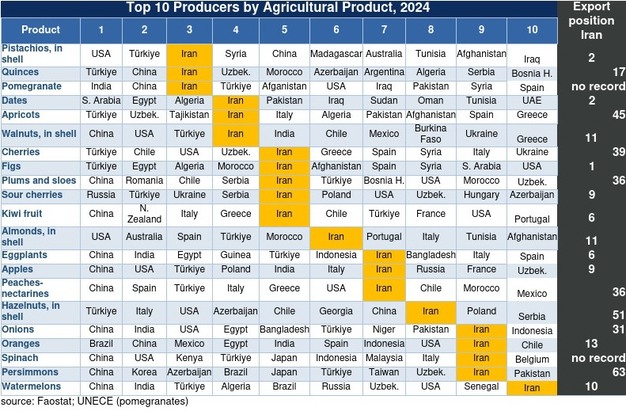
Iran ranks among the world's top 10 producers of fruit, vegetables, and nuts in 20 different categories (by volume). These include pistachios, quinces, pomegranates, dates, apricots, walnuts, cherries, figs, plums, morels, kiwis, almonds, eggplants, apples, peaches and nectarines, hazelnuts, onions, oranges, persimmons, and watermelons, according to FAOSTAT figures for 2024. Apart from stone fruit, quinces, hazelnuts, onions, spinach, and persimmons, the country also ranks among the top 15 exporters for these products.
 © FreshPlaza
Precise figures for trade flows that do not involve the EU are difficult to obtain. Due to international sanctions, Iran does not fully report its trade data to international institutions, meaning figures from different sources can vary and are not always fully up to date.
Exports mainly to the Gulf states and Central Asia
Gromita, an Iranian exporter of fruit and vegetables, states on its website that Iran primarily exports to the Gulf States (Iraq, United Arab Emirates, Oman, Qatar, Kuwait, Bahrain, and Saudi Arabia), as well as Syria, Turkey, the Caucasus (Georgia, Armenia, Azerbaijan), Russia, Central Asia (Turkmenistan, Kazakhstan, Uzbekistan, Pakistan, Afghanistan), and India. These markets are estimated to consume around 5 million tons of Iranian vegetables annually, valued at approximately €1.3 billion. Fruit exports are estimated at around 4 million tons annually, with a value of €2.6 billion, according to Gromita.
Barely imports fresh fruit and vegetables
TradeMap reports lower figures: €260 million for vegetable exports and €1.4 billion for fruit exports in 2024 (Chapters 07 and 08 in the Harmonized System). According to the same source, the trade balance in fresh produce clearly favors Iran. Imports of vegetables in 2024 amounted to around €160 million, mostly dried pulses, while imports of fruit and nuts reached approximately €570 million, with more than half consisting of nuts. Fresh fruit and vegetables are rarely imported, with bananas as the main exception.
These imports are now largely at a standstill. Exports are also officially halted. Since 3 March 2026, an export ban has been in place on all agricultural products, according to Tasnim News Agency, a pro-state news outlet.
However, given Iran's substantial production capacity, the question remains where its export limits would lie if the country were to be freed from trade barriers.